Monday, May 22, 2017

Back Issue Week Monday

This is a continuing feature here, giving a number of comics to enact a search for, and to recommend them as being worthy of the time, the effort, and money to find and purchase. 

TUROK SON OF STONE
Published by Gold Key 

I do not know who was the writer and I have no idea if I could find the name of the artist or not.  The stories are exciting, very well done, interesting, and were perfect for me, who as a kid, loved dinosaurs, was often the "Indian" to my brother the "Cowboy" in play, and loved the world of comics.  I cannot tell you that all of the comics are solid, but I have never, ever, read one I didn't enjoy.  I don't know how common it is to find these, but I know I've seen them go for insane amounts on ebay, and for as little as a buck a book at conventions.  For me 3 bucks on down would be a steal for any of them in reasonable condition.


T.H.U.N.D.E.R. Agents
Published by Tower Comics
Written by Len Brown
Art by Wally Wood

The series T.H.U.N.D.E.R. Agents and other series from Tower were amazing for their day.  Each possessed amazing art, new, interesting characters, and no overarching continuity from dozens of years past that gave you shortcuts to the stories.  Each was complete in itself, being dependent not, upon the previous works, but succeeding only if the story at hand worked.  The art on various issues, with Steve Ditko, Wally Wood, Reed Crandell and others, was beautiful.  I was not aware of these as a child, nor even as a teen.  My first encounter was in the late 1980s, when I said, what the hell are these.  They have become collector pursuits, but I am not saying buy them to speculate and make money.  I think, for their day, were rare gems in the vast world of common and old super hero stories.


EVANGELINE
Published by Comico and First Comics
Written by: Chuck Dixon
Art by: Judith Hunt, Jim Balent and others

Every now and then you meet a comic that has a great concept, quality work by the talents on board, interesting characters, and a setting that is perfect.  If you find it, then you are going to have to find every issue.  Because if the concept is great, it doesn't mean the comic will be.  If the writing and art is great, it doesn't mean the comic is great.  Some characters, like Spawn are flawed in their concept, but there are issues of it that are brilliant. 

Evangeline as a concept was rather different.  The art and writing in it were amazing.  And the setting?  The 23rd Century earth, after the world was a wastleland in areas, deserts, but also, areas of remnant modernity, and areas of wild life that is new, different, and very very ancient.

The character?  Oh she was very different.  Not by today's standards, no, but the world has changed in 30 years.  It has changed a great deal.  Evangeline was vigilante nun, who was also willing to be sexy as the situation needed, and deadly, taking her orders directly from her boss, Cardinal Szn.  In the 23rd century various powers, such as major churches, groups of people with similar outlooks, and remnant powerful nation states with dangerous technology, scarce now in the changed, wild world.

The writing was my first introduction to Chuck Dixon's work.  It was brilliant.  And the initial artist Judith Hunt took great care to depict the heroine.  I loved the series, and wonder, why can't there be a tpb collecting it?  Oh well, at least this series is relatively inexpensive, and whether through Ebay or at a local comic shop or convention, you can pay as little as 2 bucks a book and collect the whole series.

I sure would like a collected edition, though.


FANTASTIC FOUR 1234
Published by Marvel Comics
Written by Grant Morrison
Art by Jae Lee

Grant Morrison is my favorite comic book writer.  I liked his DC work more than most anything else by anyone else.  But I chose this series because it is relatively easy to find, inexpensive to buy, and a very fun to read.  I might not be a hard core super hero team buyer and reader.  I used to be, but my tastes have changed, evolved, matured, over time.  But I always liked the Fantastic Four.  For me their stories were different than other teams, and the reason was : as a team they were truly a family, and, their adventures were, indeed, adventures.  While they saved the world, and were heroic, they were more about learning new things, meeting new people, and traveling across the universe.

Grant Morrison often challenges conventions, and all of his work is different in ways of content, conventions of the industry, and expectations the reader might have going in.  In this clever work he goes back to the early days of the FF becoming a team, when Prince Namor, the Sub-mariner challenged Reed Richards over the romantic interest of Sue Storm.  It isn't a retelling, but the story harkens back to the days of that time, and, the art fully translates the lust and love going on.

This is an awesome comic, and one I enjoyed, first read, and many more reads thereafter.


Thursday, May 18, 2017

Nothing Ever Ends


It's been said that The Golden Age of Comics is Twelve, meaning that the comics you first read when you first got into reading comic books always seem to be more meaningful and more special than comic books today. For me, that era was about the time I graduated from college and finally had the disposable income to buy comic books for myself.

So maybe it is just nostalgia talking, but nevertheless I think that the mid-to-late 1980s was an incredible time in the comic book field, especially for fans of DC Comics. The company had just dismantled their long-standing multiverse in the CRISIS ON INFINITE EARTHS and every month readers could watch them rebuilding the universe, issue by issue. John Byrne was retooling the SUPERMAN titles; George Perez was breathing new life into WONDER WOMAN; Frank Miller was startling us with his dark violent take on Batman in THE DARK KNIGHT RETURNS; new or re-vamped characters were being introduced into the DC Universe.

And then there was WATCHMEN.

To begin with, WATCHMEN was a completely radical rethinking of the most revered cliché of comics, the costumed crimefighter. The writer, Alan Moore, was already a rock star among comics creators for his dazzling work on the British comics MIRACLEMAN and V FOR VENDETTA and his reworking of DC Comics’ SWAMP THING. Moore wanted to totally re-think the super-hero and create a story about what would happen if super-heroes existed in the real world. 

The idea of realism in comics in itself was nothing new; Stan Lee had ushered in the Marvel Age of the 1960s by giving his heroes realistic characterizations. In the early ‘70s, Denny O’Neil brought "relevance" to comics by addressing social issues in GREEN LANTERN/GREEN ARROW. But WATCHMEN took this trend much farther. It was part of a huge surge of "grim ‘n’ gritty" comics in the mid-to-late ‘80s that re-defined the genre.

WATCHMEN is set in a world in which Richard Nixon is still president and considering running for a fourth term in office; Vietnam has been admitted as the 51st state; most cars run on electricity and the world lies teetering on the brink of nuclear war. All this can be connected, directly or indirectly, to the superheroes who once operated in this world. Most of them have retired now, since the government ban on masked crimefighters several years past. One of them, a psychotic vigilante named Rorschach, never quit; and when a former hero turned government agent named the Comedian is found dead on the sidewalk beneath his penthouse apartment, Rorschach believes it is murder and that someone is out to kill his former associates.

As Rorschach investigates, he and the other heroes find themselves drawn into a plot to commit an act of violence that makes the 9/11 attacks look like a fraternity prank. But the purpose of the horrific crime is to prevent a worse one: nuclear Armageddon. The heroes fail to stop the plot; but as a result of their failure, the world is saved.

Dennis, the resident intellectual of our comic book club, insisted that the Ozmandias, the mastermind behind the plot, was the real hero of the series because, after all, he did save the world from nuclear destruction. (Although to be fair, a major element of his plot brought the world up to the brink). The central theme of the comic, Dennis said, was an inversion of the standard comic book plot. In comics, any problem can be solved by beating the snot out of a bad guy. WATCHMEN points out that the most serious problems in the world can’t be solved that way; and so it falls to the "bad guy" of the story to solve the problem of nuclear war.

I think, though, that Dennis was also being a bit simplistic in his analysis of the story. There is another moral in Watchmen that I think he missed. It comes near the end. After the climactic confrontation, there is a conversation between Ozymandias and Dr. Manhattan, a super-hero with near omnipotent power who is frequently used in the story to symbolize God. Ozzy asks Manhattan if he did the right thing, if it all worked out in the end. 

Dr. Manhattan replies, "In the end?  Nothing ends, Adrian.  Nothing ever ends."

He then teleports out of the room; and we see Ozymandias looking puzzled and concerned. What the heck did he mean by that?

When Zach Snyder came out with his 2009 movie adaptation of WATCHMEN, I was interested to see if he retained that line. Snyder's version was remarkably close to the original comic, not only taking dialogue directly from the book, but often striving to re-create the comic panel by panel. He did use the line “Nothing ever ends,” but gave it to another character, the Silk Spectre, who quotes it to Ozzy as a something Manhattan liked to say. The way she delivers it, she makes the line sound hopeful and life-affirming; but that's not how Ozymandias took it in the graphic novel.

I think I know what Dr. Manhattan meant. In that scene, Ozymandias was really asking if the Ends Justify the Means. Here Ozymandias achieves achieves World Peace and the Cessation of the Arms Race … at the cost of half the population of New York City. Dr. Manhattan does not answer directly, but his remark gives us a clue. This is the moral I took from Watchmen:

The Means that we use to accomplish our Good and Noble Ends have consequences and repercussions that far outlast those Good and Noble Ends.

Call it the Law of Unintended Consequences. Or, alluding to another graphic novel, you can remember the Road to Perdition and consider how it is paved with Good Intentions.

WATCHMEN ends on an ambiguous note. A brighter day has dawned. The United States and the Soviet Union have joined together and a new era of optimism and peace is unfolding. But this peace is a fragile one; a chance action by a simpleton in the final panel may undo it all. And that situation, with the guy’s hand hovering over the diary that could reveal the whole plot, was indirectly the result of the murder which began the story in the first place.

There the story stops. It’s deliberately open-ended.

Because nothing ever ends.

Tuesday, May 16, 2017

Just a matter of time


"Whether if soul did not exist time would exist or not, is a question that may fairly be asked; for if there cannot be someone to count there cannot be anything that can be counted, so that evidently there cannot be number; for number is either what has been, or what can be, counted." Aristotle

Time is an enemy of human life.  The more it passes the older we get.  Since life on earth comes with a final end point, we measure time, with extravagant concern, and we crawl through life furtively, as if, we might escape its fate.

But does time really exist?  Isn't it a concept that allows our minds to understand why we age?  So, is there a past that can be reached by the present?  How could that be?  I've seen a great many comics about time travel.  I understand the point of them all, but, Doctor Who and all of these stories aside, I am not certain anything could be done to visit past ages.

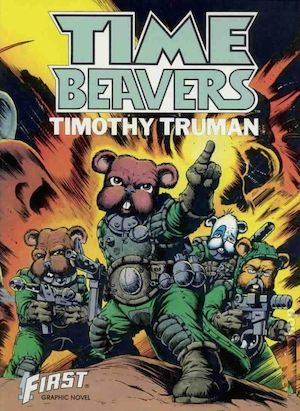
And why the hell would anyone want to?  I am 53 years old, I have survived two blown appendixes, yes two, staph infection of my heart WHILE I was getting chemo for CANCER.  I had thyroid disease and treatment.  And on 4 occasions doctors told me You should be dead.  If I went back in time, I guarantee you, something would happen to me, and I'd die.  They don't have doctors that could save me, they don't have space heaters, they don't have internet, they don't have comic books.  So I don't want to go.  But all of the characters in the shown images did want to, and their stories are found here.

TIME BEAVERS was a hoot.  Perhaps naive in its outlook, it is an adventure that goes from 17th century France to the Lincoln Presidency, Hitler's Germany, finally to the Great Dam of Time.  The Time Beavers are warriors, of a sort who protect the time stream, and the various threads of potential crisis.  The graphic novel is fun, but better illustrated than written.  The concept is silly, but with a name like Time Beavers were you expecting anything else? 


The story revolves around a time traveller named Ace who often has to risk life and limb to save the timestream.  A 23rd Century man, Ace is a world traveler, and a time traveling world traveler.  From Ancient times to the future he tries to make the timestream flow correctly.Aztec Ace used a pseudonym when in different eras, occasionally T.A. Zek.  His time in Ancient Egypt and Maya and Aztec Mexico showed his interest in things cosmic.  And he encounter an ugly bastich called Nine Crocodile, who wished to unravel the present and past, to leave only limbo, his personal realm.  The stories are fun, and, if you like metafiction, they are rewarding for the way the writer inserts the lead character into scenes of movies from the eras he travels to.


Rip Hunter was a DC comics 1960s weird science character.  He was not a super hero, rather  an ordinary man who uses his invention, the Time Sphere to visit other times. His friend Jeff, girlfriend Bonnie, and her brother Corky, there is a team of adventurerers.  This character and series was not boring, but it wasn't thoughtful.  It is the kind of comic you can read in the restroom and forget 10 minutes later what it was that you read.  Still, it has its charm.


Alan Moore was known to be a super writer following Swamp Thing.  But these are a variety of stories, with some level of quality from his (and others) 2000AD work.  The most interesting is the character Dr. Dibworthy.  The stories follow the time trips taken and the adventures that doing that leads to.  Some of the time travel happens only in the mind, but the rest are quite physical and some are quite funny.  (Actually, I think they are reprints from 2000AD, but can't remember, and don't have the comics nearby to check.)


The Chronos Files: Time Trial follows the adventure through time by a doctor of great time travelers, who had, incidentally, saved time.  She has some innate abilities regarding passing through time, and has the sensibilities of girl from 1931, but, her understanding that time is a path, not a stationary obstacle makes her more "worldly".  The stories are great, and deserve an audience.


The Time Breakers and The Black Lamb were the two best series that DC Imprint Helix put out.  Time Breakers features a team of unusual people who are dedicated to tie up the loose ends of time travel, extinguish paradoxes found in the stream, and seek a long term solution to the problem, the end of time itself.  I like Rachel Pollack's writing, and Chris Weston is so bloody good I can't even stand that he doesn't have a dozen more series out.


Although the character Chronos was originally a villain, this series is not about that version of the character.  This Chronos, with the civilian name of Walker Gabriel, was revealed to be the son of a temporal theorist who had worked with the original Chronos.  The father also created Chronopolis, the city beyond time. This series takes a character who had very little nobility in him, to negating time lines that were going to cause a horrible tragedy with his acts.  In the end his decisions even affect his existence in time.  A thoughtful series, worth a read.


I liked Timespirits.  I didn't love it, but it was an entertaining ride about an elder with knowledge of more than the present world, and a youth from his era.  The elder travels about, and finds in the youth a great talent for being a time spirit.  They go about their adventures visiting eras and places, and not necessarily leaving them unchanged.  The art is beautiful, and the story rather fun.

Tempus edax rerum
Time, the devourer of all things
Ovid

Friday, May 12, 2017

A Discussion of the world of comics, with writer, artist, former publisher, Erik Larsen.

I have a great amount of respect for Erik Larsen.  I am a fan of his work, but more, a fan of his striking honesty, refusal to be "politically correct", and his kindness to me, and others I know. He is great representative of the world of comics. He has worked in the comic book industry for a long time, over 30 years.  He has created numerous characters, many of which are found in the Savage Dragon/Image continuity.  As a child he began creating characters and fleshing them out, and he has seen that foundational work come to published life as a writer, artist, publisher, and co-founder of Image comics.

I've interviewed Erik Larsen a number of times.  Sadly some of my over 250 interviews were lost through website disappearances, hard-drive crashes, and the Chinese hacking of Popthought. I'm always interested in revisiting Mr. Larsen, and I am grateful for his willingness to share his view of the comics industry, from an insider's perspective.

Alex Ness: I've told you in the past that in my mind you and Walter Simonson are the true inheritors of the Jack Kirby Mantle.  There are others who suggest John Byrne is, (this group primarily being John Byrne).  I think you are this because, among other things, your comics are meant to entertain, they have humor along with action, and the way they are presented on the page, reminds of JK.

Was Jack Kirby your primary influence?  If not he seems to still show through your work.  Also, I think you should take a bow for creating a long run of a very fun comic and in that way, you are also like the King.


Erik Larsen: Jack was in the mix pretty early on. My dad read comics as a kid and we grew up with his comics. My brother and I devoured those. My sisters not so much. He let us at them when we were far too young and we destroyed a chunk of them but there were numerous survivors. The first comic book I bought that was new was an issue of the Incredible Hulk and that led to me getting into comics, eventually. My brother lucked into a run of the Hulk from some kid at school and he gave them to me in exchange for doing the dishes or something and that got me going. In a few years I was buying everything. I discovered Kirby at DC. He was writing and drawing Kamandi, so that was my first exposure and I ended up finding a few others in the mix. I took to his work immediately and bought what I could, be it Omac, Mister Miracle, Manhunter, Atlas or Dingbats of Danger Street. By the time he came back to Marvel I was all in on Jack Kirby.

As far as longevity went—I didn’t immediately know that Jack did long runs on the Fantastic Four and Thor. When I came into contact with him he was on books that didn’t last that long. Kamandi being the obvious exception.

Alex Ness:  How hard is it to be so regular, and productive, when you see others fall away, or even don't finish mini series?

Erik Larsen:  I don’t really take into consideration what others are doing. I’m making my own comics and doing what I want to do. What others do is up to them. There is something of a temptation to do other stuff from time to time and I have dabbled a bit but Savage Dragon is home.


Alex Ness:  The comic book industry has shifted to digital in many areas.  Some say there are still the same amount of readers, they just moved to reading electronically for the most part.  I think you and I could agree, there is a shitload of people downloading for free.  How does the comic industry stop that, and, what happens if it doesn't?

Erik Larsen:  Well, clearly it can’t stop it and when the numbers fall enough comics get cancelled. Ultimately that’s the end result. Comics need a certain amount of revenue in order to keep going. If that goes away—comics go away. But policing it is next to impossible. It’s a huge problem. And every individual taking stuff with the excuse that they’re only one person and that they wouldn’t buy it anyway exacerbate the problem. At some point it all goes away.

Alex Ness: Alterna has begun a return to newsprint and lower cover price. Is that a way to bring in new readers? Can it sustain itself? And, this might sound snarky but I don't mean it as such, isn't the best way to bring in readers is write and draw the best work you can? Isn't newsprint and lower prices a symptom rather than the cause of the lower sales?

Erik Larsen: Nobody seeks out a book because of its cover price. If it’s inexpensive — that’s great—but if I don’t like cauliflower it doesn’t matter how inexpensive it is—I’m not going to buy cauliflower. If a book is insanely overpriced, sure, that’s an issue but comics are still a relatively inexpensive hobby as long as you don’t buy everything. The goal is to produce the best book you can at the lowest possible price. Fans seem to think this fancy printing is the cause of all of their problems. They seem to think a return to flat color and newsprint will lead to lower cover prices and that sales will boom if that happens—but that’s nonsense. If I want a book—I’ll buy that book regardless. If that book costs 50¢ less—I’m not going to buy two of them. I’ll still buy one. I don’t go into the store determined to spend $20 and if prices are lower I’ll buy more books—I’m there to get the books I want and if that’s one comic book—that’s all I’m buying.

It’s also a false assumption that slick paper means a higher cover price. At this point, comics on slick paper can be coverless. Most of the comics on the stands now are coverless. In the old days, we’d print a 32-page comic and add a cover bringing the total to 36 pages. Now we’ll just print the interior 32 pages and format page one to look like a cover. But it’s all the same paper. The whole book is on the same cover stock. But you can’t do that with a newsprint comic—it’ll look terrible. So you’ll need two paper stocks and two presses to run off a newsprint comic book while a modern comic requires one stock and one press. In most cases, it’s actually less expensive to do a slick 32-page, self-cover book than a 32-page newsprint comic plus cover.

The conversation about why this works and why that doesn’t is long and involved. There’s no simple answer.


Alex Ness:  Let us say there is a disease that could remove either your drawing talent, or the writing. Which would cripple you more?  I know you've written without also doing art, and vice versa, as a storyteller, do you far prefer doing both jobs?  Why?

Erik Larsen:  I’d lose the drawing. If I lost the writing that’s a mental disorder and I don’t want to have to cope with that. As a storyteller, the two work in tandem. I’ll plot in my head as I draw and script afterward. Sometimes I’ll type dialogue as I think of it, midway, other times I’ll jot down notes in the margins but most often I’ll just script the book in its entirety after it’s fully drawn. It’s just the pattern I’ve fallen into.

Alex Ness:  Savage Dragon is into 220s and few comics in the 21st century have seen such a trajectory, especially independent works.  The only one who did more would be Dave Sim doing 300 issues of Cerebus.  Is the reward worth the labor you've put in?  Does the reward in the end not matter because your journey was so great?

Erik Larsen:  My goal is simply to keep going. I don’t worry too much about the reward. The book sold far better when it started, go in that regard, it’s diminishing returns. I can do the best book of my career and it’s still going to sell worse than whatever I did 25 years ago. If I dwell on that I’ll drive myself to drink.

Alex Ness:  Would you have anyone take over your characters upon retirement?  Why or why not?

Erik Larsen:  Likely not. I just don’t want to see it. If I did—I’d never look at it. It would be like watching your best friend screw your ex-girlfriend. Nobody wants to see that.

Alex Ness:  When Image was born the group of creators seemed to come ready with characters that they had developed before and during work for the "Big Two".  With the proliferation of POD, smaller press, and more options including IMAGE, do you think creators are still doing this?  Or are they able to do their dream work far sooner?

Erik Larsen:  That’s more of a question for them. And there’s no one answer. Everybody has a different story. Some find huge success doing their own stuff and some struggle with it.

Alex Ness:  How much of Savage Dragon is Erik Larsen?  How do you hide your green skin?

Erik Larsen:  He’s all me. But so is every character to some extent. There’s a part of me in everything I do.

Alex Ness:  I've been told many times, by many different creative people, that of all the media out there, comics has the most jealousy, envy, and infighting. There are some famous feuds Image guys were in, but would you say that is the medium or the fact that young creative guys are passionate?

Erik Larsen:  I don’t believe that for a second. From my own personal experience it’s pretty minimal. I would expect it to be far worse in other industries. My experience is that, for the large part, it’s a mutual admiration society. People get along famously. The handful of feuds seem inconsequential to me.

Alex Ness:  If you were to offer people 5 comics to prove comics kick ass, what would you offer?

Erik Larsen:  That’s a hard one. Most of the books I love are parts of ongoing serials and without the context of that series a lot is lost. Thor #337 is fantastic but it’s far better in the context of the ongoing Thor comic book. Same with Incredible Hulk #156, Amazing Spider-Man #33, Swamp Thing #21 and Kamandi #6. As a good entry level book—Scott Pilgrim’s Precious Little Life is a good start.

Alex Ness:  I used to be able to draw, and draw fairly well.  But after a gap of time, and body aches, I can't come anywhere near where I was.  Does talent ever fade, or am I witnessing a loss of skills that I had learned?

Erik Larsen:  From what I’ve seen—yeah. It can fade. Certainly eyesights can fade and skills can decline. I’ve seen it with numerous artists over the years. And there are other factors. Influences change, tastes change, you can get stuck in a sort of time warp where your work is stuck in the ‘70s or ‘80s or whatever decade that you stopped paying attention to. It can be a real challenge to stay fresh and keep moving and this can be made doubly frustrating due to fans’ nostalgia and their inability to let go of the past. There’s no winning to some degree. If you maintain you’re "stuck in a rut"—if you evolve you’ve "lost it.”


Alex Ness:  What excites you about the comic world today?

Erik Larsen: The next issue, always. I’m always looking forward to my own work and what my peers are doing. There are some fantastic books out there. Many of them are truly humbling to look at.

Alex Ness:  You contributed to the Spawn recently.  Doing pencils and story?  How was it working on another founder's character, was it remarkable in any sort of way?  I know I thought the art was magnificent.

Erik Larsen:  I contributed to Spawn doing fully inked yet somewhat sparse pages and script—both of which were thoroughly revised. The only remarkable part was how incredibly frustrating and miserable it was. I had more writing changes made on a single page than the rest of my career combined. And the art changes were often infuriating, as Todd moved panels from one page to the next with no consideration to internal continuity or story flow. It was just sloppy and poorly done. I thought, well, sure after the clumsily-named Satan Saga War, which was supposed to be his story, he’ll back off but that didn’t happen. The only reason I stuck around as long as I did was because a few covers had been solicited and the last of them was a crossover with Savage Dragon. Hands down the most infuriating collaborative experience in my lifetime.

Alex Ness:  Tell us about the character/property ANT, and what you intend upon doing with it. How did you come to acquire it?

Erik Larsen:  When ANT came to Image in the first place I’d talked at length with Mario Gully about changes that needed to take place with the book in order for it to work as part of an Image Universe. Prior to the book coming to Image, Mario Gully had done an ANT miniseries at another publisher and it was the story of a little girl who had elaborate fantasies about a superhero which she drew in her diary. I’d told Mario that it would be impossible for ANT to interact with any Image characters because she didn’t really exist—she was a series of drawings in a diary. So I ended up putting a lot of thought into the character from the start.

I was somewhat hands on as the series progressed, helping arrange appearances by other Image characters and suggesting collaborators and so on. I’d even laid out an issue for Mario to draw which was never completed. So, Mario knew I had some love for the character and was invested in her. Some years later, Mario contacted me and said he needed to sell the character and that he had been talking to another party but he said he’d rather have ANT with me. He told me how much he wanted and I paid his asking price.

Alex Ness:  I am a Christian and you are an atheist.  We are friends, in my opinion.  So this isn't meant to be derogatory... Both you and Todd Mc (who similarly is an atheist) have characters who have met or dealt with or tried to kick the ass of GOD.  I wonder why you did this, not asking you to defend it, but wouldn't it be an opportunity to show a cosmos minus the trappings of religion?  As a personal note, I write about the Greek Gods more than I do Christian, because, probably, they are more individually human in their traits.  Also, I mean only to express universal truths, not a literal God while I do so.

Erik Larsen:  It’s fun to play in a world with more toys. I’ve had Santa Claus in the book, I’ve had the Easter Bunny, I’ve used Public Domain superheroes, and various gods from numerous religions, so it seemed like a fun idea to play with. I also had an idea that I wanted to explore. I wanted to have there be an afterlife of sorts in the book. I wanted to come up with an idea which could reconcile the differences in all religions as well as Atheism. The notion that when we die—we’re filled with a sense of having been right—and that we all choose our own afterlife, which I thought was an intriguing idea.

I had also been thinking about Galactus and how his presence was diminished with each successive use. I wanted to use God once, and once only, and never touch him again. Just do it once and drop the mic.

Alex Ness:  I've watched you on Facebook and before that on various message boards give lessons, teaching about art and the way to be a comic artist.  Have you taught in any actual classroom? Because, I think you already kick ass doing so.  ((No nay sayers, that is not my nose up his ass, I actually think he is awesome in how he translates it for the common person.))

Erik Larsen:  I’ve thought about it and I’ve done a class or two at shows or in an actual classroom setting but I simply don’t have the time.

Alex Ness: Humans are born with different talents, IQs, different parents bring more differences, and different families in different nations of the world makes the individuality complete.  That said, do creative people have a gene or something unique in them that makes them need to create?

Erik Larsen:  As far as I know—there isn’t. But I don’t know. You have a handful of comic book artists who have children who are comic book artists but most seem to be one offs.

Alex Ness:  When you watch a movie, do you sequentially adapt it while watching?

Erik Larsen:  I do not. I’ll just take it in.

Alex Ness: When you read a fiction novel, do you think wow that would look like this in your mind? Do you, I guess I am asking, create while you are supposedly not working?

Erik Larsen: Not really, no. Not in that sense. I do think plot constantly—I am continuously trying to plan ahead and think of scenes but the notion of adapting a film or book just isn’t there. I have zero interest in realizing somebody else’s world. I like to enjoy other people’s work for what it is. I will occasionally look at the real world and imagine how it might be depicted with lines on paper but I’m not tempted even a little to adapt other people’s stuff. So much so that unless I’m specifically commissioned to draw something at a convention, I never just sit down and draw favorite characters from movies, books or cartoons. I might doodle an iconic superhero or two from time to time, but almost never recent characters from comics I enjoy.

Alex Ness: Are you normal with regards to your experiences growing up, going to school, and interacting with people in the world?  Or as an artist did you strike a look, manner or voice that was immediately different?

Erik Larsen: Pretty standard stuff. No posturing. I did have my head down drawing a bit and I was something of a class clown—making smart ass remarks and such but I dressed like other kids and did much the same stuff. Even went out for football in high school. Other than constantly drawing, I was pretty normal.

Alex Ness:  Is your wife a creative person too?  And your children?


Erik Larsen:  My wife isn’t a compulsive doodler but she’s currently taking a couple art classes. One of my sons draws a bit—mostly pictures of antique cars and rooms stuffed with old stuff—but he’s not pursuing art. My youngest son doesn’t draw much. Both kids at one point at least started drawing their own comic books but neither got very far. They weren’t bitten by the same bug.

Alex Ness: What are some of your favorite movies, comics, and books?


Erik Larsen: I’m a big nonfiction reader and it’s largely politics and the like but I’ll read biographies and books by comedians. I listen to a lot of comedy and enjoy that. I’m not a huge movie buff. I’ll go and watch a few movies a year in the theater because I enjoy it but I’m not one of those guys that can rattle off a long list of actors and directors. I liked the Summer of ’42 and Groundhog Day, I can watch the original Ghostbusters movie over and over. In terms of movies it’s pretty mainstream stuff, Star Wars, Star Trek, the various superhero movies. But largely I’ll see a movie once and that’s the end of it. My wife will choose and I’ll just suffer through it. I’m usually the guy suggesting a trip to the theater. She’s usually picking the movies we watch at home. I may watch a movie a week on TV—I watch pretty much nothing else on TV. I’ll watch sports if they’re on but I don’t seek them out. I’d like to get into it because I can see how much others enjoy it but it just doesn’t draw me in. I’ll watch the Super Bowl every year and I watched the World Series when the Cubs were in it but that’s about the extent of it.

I love a lot of old comic books. Comics by Kirby, Captain Marvel Adventures from Fawcett, Hulk by Trimpe. Big Frank Miller fan. I’ll read anything he does. Read the X-Men back in the day. Claremont, Byrne and Austin, up through Marc Silvestri. I read Simonson’s Thor, Moore’s Swamp Thing, all the usual suspects. Once Image got rolling my interest in Marvel and DC stuff waned. I’ll follow artists from book to book at Marvel and DC but there’s no title I’m following. I like  Chris Bachalo a lot and Humberto Ramos. I get the Image comps and that’s a treasure trove but I really don’t have much time to read but I’ll flip through it all.

Alex Ness: Thank you for all of your support of my journalistic life.  I have had numerous people in the industry try to help me, and you are among those who did the most.   


Wednesday, May 10, 2017

Back Issues to Look For

History, Life, Metaphysics and Murder


Kings in Disguise was by James Vance and Dan Burr, and released by Kitchen Sink Press.   The setting is America during the Great Depression.  When 13-year-old Freddie Bloch runs away from home when his family is torn apart, leaving him to fend for himself.  He travels America, on the railroad, and it takes him to see things that Americans sadly forget.  Labor strikes and revolts, soup kitchens, hunger that is a constant companion, and more.  It isn't superheroes, it isn't what you'd call action, but it is deep, runs through the emotions, and is beautiful, for what it is.  I am a historian, and this moved me.


I am a fan of the books Virgin Comics put out.  Most of them had different art, really interesting stories and subject matter.  And, I felt these comics were really new, depicting the cultural gems from a world I have never experienced.  But just as Virgin Comics passed away due to a lack of American consumer interest, I wondered if Buddha would make sense to the audience of comics.  I was very interested in it but I didn't know who would support it or enjoy it other than me.  That is, except perhaps for people from India, practising Hindus and Buddhists.  It tells the story of the man who became "the Buddha".  A young man, rich, trapped in luxury and excess, begins to hold his existence in contempt.  His search for meaning is captured well.  It is a biography of a religious figure, who I am not a follower of, but any moral work, I believe is a work that you can learn from. 


The main character Michael Alexander has written a book about a realm that we can visit, when our minds and alternate ego encounter fear.  The villain Chasm was a force who gains power from the fear of others.   At first I found Dark Dominion on the shelf it confused me.  I'd read that Steve Ditko had been involved, and I thought upon casual inspection that the art was indeed by him. That generally means thumbs up for me.  The confusion lifted when I learned that the character was created by Steve Ditko and Jim Shooter but the artist doing the art wasn't Ditko.  And yet he seemed to draw in Ditkoesque style. And did do a fine job of capturing Ditko's mojo.  While it was a dark place Shooter captured in his writing, there is a mix of different tones, by pieces.  The art was light, the stories were dark and dangerous.  It was an enjoyable read, and I'd love a collected version of it. 


A child murderer who has a distinctive whistle hunts the children of Berlin in early twentieth century Germany.

This movie was a classic, and had a variety of great roles, acting, and direction.  In Germany, the time had recently seen murderers who had hunted the weak and the young.   Peter Kurten, Carl Grossman, Karl Denke and Fritz Haarmann had murdered, harvested the flesh and sold it as meat, and used the sorrow of others to please their sadistic needs.

Everyone reading the prestige series M can appreciate the art.  It is magnificent, unbelievably true to the work it adapts, and I love the film to begin with.  Some people might say, but I can just watch the film... yeah, I guess you can.  Why have anything but movies then.  Why bother?  I enjoyed reading this as much as I do the movie.   I love Fritz Lang's work, I love Jon J. Muth's work.  M is a smashing victory.  If you don't get why I think it is great, I understand, not everyone likes the same thing.  But this is a pleasure, and not a guilty one.


Tuesday, May 9, 2017

What the hell are they thinking?

Josh Howard wrote and illustrated a multi volume tale of a warrior.  First she died, then she got better.  She understood her opponent, and carried the war to them.  Then she realized, it was much more dangerous than what one person could do.  So she raised a rebellion.  And with this comrades, she took the fight to the heart of evil.  Dead@17 has powerful women heroes.  Men are there, but the lead character is a girl, who died at 17.  Comic publishers across the board have sought to build a female audience, and they've done better in recent days than the previous 3 decades.

But this book is great, and is worth noticing.


His art alone is worth the price of admission.  He has a style that is young, energetic, smart, and is beautiful.  Anime and manga fans would deeply enjoy his work.  They could see his understanding of the form, and mastery of the conventions of the genres and formats.
 

And he has an impressive body of work on other stories and illustration for Topps cards.  However, similarly to the previous series, his stories feature strong women characters.  They draw attention and capture the reader's attention.  But while they are attractive, but they are deeper in conception and more interesting for their thoughts, than they might seem, from superficial glance.


But I want the reader here to understand my issue.  Why aren't comic publishers gathering at Josh Howard's door?  He is talented, has a work ethic that sees continual production, and his style and perspective aims at a community, a group of readers who have only recently seen efforts worthwhile to garner their attention.


Why aren't the publishers asking him for work?

I don't know.
I find it curious.

Friday, May 5, 2017

The League of Extraordinary Gentlemen considered

CONSIDERATIONS OF THE LEAGUE OF EXTRAORDINARY GENTLEMAN

Published by DC/ABComics and Top Shelf Comix
Written by Alan Moore
Art by Kevin O'Neill.

Imagine if you will a world that is alive with the fictional characters that have been created by creative artists, and that they've powers as written, so the world can't do anything but be different, and its history forms entirely differently than in our own world.

The League of Extraordinary Gentleman is a work that not only has heroes and villains, as in the world of comics, but these are real, there are a vast number of them, and they have a real effect upon the world in which they live.  This is not Metropolis post Superman and Brainiac fighting, destroying the city, and the next day it is fine.  The cast fight and try to save the earth, whenever challenged, but they go about things differently than say, the Justice League, or Avengers, because they are not, for the most part, invulnerable.  The consequences of this vulnerability creates many story passages that are, ultimately, more satisfactory than the "superheroes", because there is a consequence of their actions, their heroism is performed at a cost, and they exist, afterward in the world that they helped save.  


The characters found in the LoEG are drawn from many sources, gods, humans, freaks, geniuses, and all genders.  They are drawn, also, from myth and legends as well as popular fiction, esoteric movies, and characters drawn from copyrighted material who are a pastiche, or deliberately called a less trademarked name.  For instance, James Bond is a part of the stories, but called Jimmy, to avoid the wrath of lawyers.  There are so many sources and choices for characters it is hard to collect them all and still be cogent.  As such, I should say, this is by no means a bad thing.  The depth of each character and use, brings all of popular fiction, from comics, to pulps, to novels, to movies, to legends, and myths and even Japanese Kaiju to the table.  When you can see Randolph Carter of HP Lovecraft's world being the grandson of John Carter, who became a Prince of Mars, you can enjoy the conceit of it all, at the same time be fascinated about every crumb of information passed down to the reader, through character interactions, mentions, front page of newspapers, and more.  

The main characters are both human and different from human.  While we see many odd events and use of powers, we don't see nearly so many as from superheroes.  And with the cost of each adventure being potentially death, there is a feeling of actual threat.  Whether encountering or fighting Fu Manchu, Godzilla, Moriarity, the Anti Christ, David Palmer from the series 24, nothing is taken for granted, the reader knows there are so many tricks that can be played.  At the same time, I am not suggesting that the surface level story isn't excellent.  The layers of lives, fictions, and events that are added together could well have been shit.  One simply needs to look at the movie of LoEG and see that, just because an idea is great, it doesn't mean everyone will have the same results in using it.   The series is also very interesting from a history of pulp novels, adventure paperbacks, and more, that it is able to recreate a league for nearly every era of civilization.  And as a historian I am deeply impressed with the writer's deft use of fiction and fact.


A great many people will read an issue of LeOG and not realize what they've missed.  That is a part of parody and satire that is "dangerous".  If a person uses an ethnic slur ironically, being deeply offended by the word, anyone not familiar with the person using it can, perhaps rightly so, imagine and condemn that person, with no knowledge of their motive/use.   This means, the more you know, the better this book is.  Anyone can enjoy it.  I have no issue saying that.  But the more you love the  characters used, in the way they are used, will yield significant enjoyment.


An aspect of the series that is often ignored, but is important, is the art.  The artist has a style that is very similar to the Victorian era works it here depicts.  The front covers are often torn from real sources and parodied, and while again, the reader might not see it, there is a level of fiction being created that has so many layers, due to the expertise of all involved.  This adds so much to the metafiction of Moore's characters and world.  I like the art as much as the writing.


I told someone that I was reading the works of this series, and they replied, "I don't get it."  And I asked what do you mean?  They said, "I don't know anyone and it is confusing."  I can say that if you read every page it will not be confusing.  If you wish to blast through all of the volumes in five minutes, well then you get what you pay for.

The depths of this work, like so many by Alan Moore, makes it one of the best works I've ever read.   It is constantly interesting, compelling, and rewarding.


As one might suspect, their exists a number of guides to understanding the LeOG.  They are excellent, but more for the aficionado than newb.  They add a layer to what I thought was already a lot of detail.


THE VICTORIAN

Not herein reviewed, just suggesting that the Victorian is a similarly intriguing tale, following the work of a hero destined to take down a major conspiratorial group that threaten the workings of government and finance.  These are highly recommended, but are not quite of the level of LoEG.


RUSE

The Ruse series, by Mark Waid, Butch Guice, and others, follows a Victorian era detective who has a bright female assistant, and a dangerous, and beautiful enemy.  It is very much like a James Bond story from 150 years ago, and it is quite light and enjoyable.  It, like the Victorian, is very good, but not in the LeOG league, so to speak.


Thanks to Top Shelf for their providing Volume 3.  It was a joy to read.

I will be back next Friday with another entry into the world of Comics and popular culture.