Tuesday, July 21, 2020

Is it the end?


I think you'll note that I've written a few columns here about the future and how it might be considered through our various popular culture.  But I thought here that it might be fruitful to look at also some more serious works, along with some fine media choices. Science and the future can be positive.  I am a very big fan of DC Comics' Legion of Super Heroes, and up to a certain point there was so much joy and innocence in that title, series, that I felt that it was a perfect balance to all the various offerings of doom and gloom.


PLAGUES, VIRUSES, AND GERMS.

The current Ebola event in Africa (in the present of 2014) has scared the bejeebus out of many people. The disease is harsh, and the fear of it is reasonable considering the toll. But it is by no means a new thing that disease can throw the world into upheaval. The Black Plague and other plagues changed the structure of society in Europe especially. Money became concentrated in fewer hands because, of course, families were losing members, and sometimes entire families died.  When the elders were gone, inheritance and the lack of siblings created a pot of gold for the survivors to upgrade their existence.

COLLAPSE.

The hungry sheep look up, and are not fed,
But swollen with wind and the rank mist they draw,
Rot inwardly, and foul contagion spread ...

Environmental collapse, as we see with the bee population, and various extinction events, is a very dangerous situation.  We have very few ways to fix the world, if we get so far as to cause a collapse of any of the important links to human survival. Without bees, their pollination won't occur. If that happens, NO FRUIT, no plants needing pollination. As small as bees are, we could be taken out by the loss of bees. 

HISTORY AS A GUIDE TO THE FUTURE.

Some scholars believe that we can apply lessons of the past to the knowledge of how to prevent disasters in the future. Jared Diamond, Clive Ponting and Alfred Crosby are all very intelligent men who dissect the lessons of the past to demonstrate what the future might hold. As you might guess, the answers they arrive at are troubling. The cost of modernity is high, and as the ancient peoples of the earth learned, the resources of the land are finite, and the greater the number, the closer to empty the land becomes, for resources.


HOPE?

However while each of these books are very well written, and come to conclusions that should shake you down to your foundations, the truth about existence is that we can hear the facts, and stop our forward motion. Thankfully, any tale of warning about the future comes with a potential to change our ways. Also, I think it is important to note that while there is reason to fear, people have feared the encroaching disaster for millennia.  I'm not saying everything is rosie, but I am saying, we can make choices that are better than those we've made. The reason you don't teach algebra in kindergarten is because the child has no concept of theories and ideas presented. But you can teach it by 9th or 10th grade.  The difference is that after 9 years of education, a child becomes mentally conditioned to think. Learning is a good thing, perhaps reading these warnings have fallen upon deaf ears in the past, but if my theory that humans grow intellectually through experience, we have a chance.

In the past it is known that at various times the common people believed in false things. Whether or not it helped them in life is another story, but, at one point in our more recent past, the renaissance occurred because scholars abandoned certain paradigms and said, we need to know better. Not every false belief is bad, not every scientific choice is great, but in this case, the choice to further study and abandon certain beliefs pushed human mental progress forward.  All books presented here are worth your time to read.  You might not agree with the concepts or theories, but at least you'll be better informed to make your choices.

July 2020 REVISION

I am aware that the world is entering dangerous times.  We have famines, pestilence, war, and environmental disasters looming.  We have a pandemic that has changed our normal.  We have a massively important election approaching.  And we have unrest and hate, violence and riots in the streets.  How can we possibly get out of this catastrophe?

Someone I know suggested that while they believed in the abolition of the death penalty, certain things happen when it is allowed. A number of criminals change their lives in a hope of avoiding the penalty, or having found a different understanding of what they are living for, they become worthy of escaping the death penalty, regardless if it is in the end imposed. I'm not suggesting we face a death penalty.  We might.  I don't know. As a person with degree fields of History and Political Science I am not one to know what the future holds, only that what we see approaching is a massive black cloud, that portents disaster.  

What should we do? If we are about to die, should we give up, give in, we will abandon our dreams. I suggest that there is hope. We have hope, however we view that, for a better world, and better individual lives.

The books presented last here move me.  Interstellar because in a fascinating and exciting narrative, there is so much more, a refusal to become extinct through determination, spirit, and efforts, and an acknowledgement that just because we do not know now, if we stay in the fight long enough, surviving, we might know later. The Swerve because we get this feeling that, nothing that has happened is important, only the future.  We inherited this earth, we earned all of the lessons of the past.  If we ignore our legacy of knowledge we lose it.

I believe humanity will fight, and win.

(This wasn't meant to be nearly as depressing as it turned out for me to write.  I was meaning to look at various eras when everything seemed to imply that the world was about to end. As it happens, humans have faced the end, and survived a number of times.  I should say, I don't altogether use my history degree to harvest depressing scenarios from the past. Also, let me say, it is perhaps true that we are so troubled by so many things because we know of so many things going on.  Humanity has never had nearly the coverage and information that it has in the present.)


72000 BC The Lake Toba, Sumatra/Indonesian volcanic explosion caused such an enormous kill of people, animals and plants, that human numbers fell to such a low number we can count most of our traits to those survivors.  Some scientists argued that humans were at such a low number that there appeared a genetic bottleneck as a result.

In 536 AD an Iceland volcanic explosion nearly killed humanity by the downstream effects from the ash in the atmosphere lowering temps, blocking sunlight, and causing the death of crops.  Facing food shortages, disease, stagnation of human learning were disastrous. This era was one of lost scholarship, snow in summer, and crop failures in moderate temperature areas, leading to a true Dark age of human history.

In 1346 AD the Black Death arrived in Europe, perhaps brought from Asia from the trade routes by then in use.  Half of Europe and vast numbers uncounted in Africa and Asia were wiped out. Human culture was changed, in numerous ways. Some historians have pointed to the Black Death as the true catalyst for when the modern world began. This is because the effects of the Black Death led to changes, including inheritances, and that money became concentrated, both investment and savings became more constant.

The Triumph of Death by Pieter Bruegel, Elder
The period of  1918-1920 AD was a period of death and disaster, across the globe.  Both the toll of World War One and the Russian Revolution and Civil War were enormous, in the middle 30 million dead range.  Add to that the toll of perhaps 50 million dead from the Spanish Flu, you end up with a very huge number of dead. However, the population was large enough then that it wasn't nearly as threatening to human existence as it might have seemed.


Are the Four Horsemen approaching, or are they already here? Are they called to our time and place Or are they set to appear upon a designated time? Does their arrival mark the beginning, and things will only get worse? They are said to represent various traits, concepts events, and are visible as harbingers of God's final judgment. Are they just figments of a religious mind?  Or would any time of upheaval seem prime for any and all of these portents.

Conquest, Death, Hunger, Plague would seem to accompany any scenario of the events leading to our world's passing. As a Christian I believe the Horsemen are a metaphor, and represent the likely events and beings that will appear at the end of our world.  But, that doesn't mean I don't believe in them.  In other words, It doesn't matter the color of the cat, so long as it catches the mice.

I was asked by a number of readers here about my thoughts regarding the future.  I see a number of future destinations that our world is going in the direction of.

The first and most obvious, is a more dangerous world. Global warming is more than heat, ocean levels, and weather. The changes it causes leads the world to react with emotions not logic, it makes the world more likely to react with violence, due to the discomfort.

A different kind of world is one that has to go through hell before it becomes better.  The societal impacts of Covid are one thing, but the riots and racial tensions have to burn through before there can be healing.  But once we get there, we are willing to make changes to get to a better, happier place.

Covid might have a long term effect upon our minds.  Even if it is a phase and will evolve out of the deadliness, we can't say that from here.  What if the virus evolves into a more deadly, and even more contagious form.  I've been told by people that it is all lies by governments, ginning up the event for the opportunity to steal rights and power.  I think when America is done with it, we'll have 450,000 dead. But that is my optimistic outlook.  If we isolate and social distance, if we hide away, we might avoid getting the virus.  But if there is never a vaccine and it never evolves into a safer form, we might be forever screwed.

But I DO have hope.  Humans have had it worse and came out to build the world we live upon.  I just want the world to be a better place for all living creatures upon it.

Death upon a Pale Horse by JFW Turner

Thursday, July 9, 2020

Milestone Reached: Issue 250 Savage Dragon


I've not covered a lot of milestones in comics, so why have I recognized this one?  Erik Larsen created his character Savage Dragon when he was a child, and has story telling ability that I find effective.  But way beyond that, I think Erik is a kind person, a thoughtful one, and he has shown a determination and effort that few of his peers have ever revealed.  Also, he has produced a long run upon a comic, along with ever other work he has been part of, that has never failed to be fun.  

He tells stories that are somewhat larger than life, but are rooted in reality.  His character Savage Dragon is an alien, but he is/was also a police officer.  He has loved a partner, loved others, has fought battles, defended the planet earth, and has traveled in various dimensions.  He has a son (named Malcolm) who at a more mature age and in a moment that needs a hero, inherits the mantle of Savage Dragon hero.  The more recent years has seen a more mature content in the work, and you should be aware of that if you seek it out.


Deep down, the reason I think it all works for me, is that there is a developed sense of humor,  joy and adventure in the stories that reminds me, constantly, of the works of my favorite comics writer/artist, Jack Kirby. The stories of Jack Kirby were big, bold, exciting, and they were not realistic.  They were, however, constantly entertaining. Savage Dragon works for me on a number of levels, and, as a 56 year old old fart, I find that it still exhibits the best of the stories that Kirby created, and I still love stories of his sort.

Issue 250 goes on sale Wednesday July 15, 2020. Guest artists Frank Cho, Rob Leifeld, Skottie Young, Walter Simonson as well as Erik Larsen created 8 covers, two blanks for artists to create their versions of the milestone issue.

Congratulations Erik Larsen, you deserve it!

Monday, May 25, 2020

Go Read Warbirds you freedom loving people!!!!

Click the above link to take you to the site.

What would the world today look like if the Nazis had won World War Two? 

It’s 1948 and WWII never ended! Instead, Earth was invaded by creatures from the stars! One small group of resistance fighters has banded together to hold the line…at all costs!

(Click all images to make larger, and all images and respective content are copyright © the owners of such works.)


I've been privileged to work with Scott "Doc" Vaughn on more than a couple projects. He is an artist who is moved by pretty women (me too), heroes and villains in epic works, and the works of the past and culture of America's Golden Era, the 1950s. He is really talented in the realm of art, and I am moved by his openness to consider new projects.  WARBIRDS follows the actions of a few brave men and women who seek to save the earth, after Adolf Hitler's 3rd Reich has recovered from near defeat, by joining forces with the aliens of Mars and their advanced technology.  It isn't a fair fight, but, when has the defense of honor, democracy, and hope ever been fought without such odds?  


I'm promoting it not just because I like it, but in the present era of fear and worry, it is fun, and hopeful. I was also blessed by Scott to be invited to work on a book that is based upon the fight found in Warbirds. I wrote two short prose pieces to develop further areas of the world considered in Warbirds, and had a great time doing so. The book has recently been brought back into print. Yes I have copies to sell.


"WARBIRDS OF MARS: STORIES OF THE FIGHT!

Bomber pilot Jack Paris. Lounge singer Josie Taylor. Bandaged avenger Hunter Noir. Mysterious hybrid Mr. Mask. Together they will stop at nothing to undermine the Martian occupation of Earth. From daring action in the South China Sea to explosive chaos on the frozen glaciers of Greenland. Watch a man transformed into a vigilante hero, as the world he knows crumbles around him. See an alien-human abomination discover self-worth in the death of a man who extends him kindness. What are the resistance plans for combating the Martian threat? Discover an awakening as two young boys journey from distant farms to the big city, to get in on the life of battle. Just what are the creeping monsters threatening the small southwestern town of Adobe Wells?

Scott P. Vaughn’s vision of a world ruled by three-eyed invaders from the popular webcomic comes to life in this anthology, with fourteen tales of intrigue, horror, and desperate action. The stories run the gamut from the air war, to the horseback of the wild west and the nocturnal alleys of battle-torn 1940s urban America. Brought to you by some of the best names in the horror, action & adventure, supernatural thriller, and comics genres. Relive the glory of the Pulp era with these stories of the fight.

With illustrations by Mike DeBalfo, Bill Farmer, Robert Hack, John Lucas, Dan Parsons, Doc Vaughn & more!"


Monday, January 13, 2020

Dystopias, first the comics, now in novels and films


1/13/2020
By Alex Ness

As I recently covered 4 great Dystopia Comics I was thereafter asked by a reader to give a similar account to the best books, and if I could films.  The main control point that I was aiming at is the dystopia doesn't come from the disaster or war humans face, but the government that is creating the dystopia by its actions.  Books however, have taken aim at the subject so often, in such detail it would take me a lifetime to write about.

BOOKS

We
1984
Brave New World
The Machine Stops
Moscow 2042
Love Among the Ruins
Fahrenheit 451
A Clockwork Orange
This Perfect Day
The Children of Men
Never Let Me Go
The Handmaid's Tale
The Sleeper Awakes
The Iron Heel
Anthem
Stand on Zanzibar
Make Room! Make Room!
Lanark
A Scanner Darkly
The City and the City
Infinite Jest
Paris in the 20th Century
Neuromancer
The Giver
Snow Crash
The Man in High Castle
Slaughterhouse Five
The Lathe of Heaven
The Trial
The Hunger Games

The common theme of these works is not heroic main character good protagonists or evil antagonists.  The enemy is rarely so defined.  In dystopia you find a enemy now and then, but what sets these works apart from the rest is that the setting itself is the real problem.  I've been writing a story and have been for decades where the government is trying to save mankind by its controls and efforts.  But, the reason it has taken so long to write, is that isn't an easy to portray world.  But what makes ever dystopia powerful to read, is watching the steps taken that establish the worlds the characters, good and evil, have to live within.  Utopia stories generally speak to the attempt to create it, or tear it down.  Dystopias are much different.  You can show the depravity of the human condition through life in a fallen state of human society.  You can show the rebellious rise against such.  But the thing that stands out for me, is how we can see the roots of the problems in our own world today.  


I think these are famous enough that you might pursue them and find it quick to acquire, and engrossing to read.  But beyond that, while there are various great dystopias, these are examples of how society will crumble with every grab by government of freedom.  We might think that we are so very important and free, but the truth of government is, any opportunity to steal our freedom, it will, and we become less free with each act.  And then ask yourself, have you ever seen government give back power or control once it has taken it?  The answer is no.

 FILM

THX 1138
Metropolis
Soylent Green
Blade Runner 
The Matrix
Brazil
The Hunger Games
Dredd
1984
12 Monkeys
La Cite des Enfants Perdus
Mad Max


There are far more dystopias to discover, but if you watch these movies and read all the books you'll have enough for a lifetime.

Wednesday, January 8, 2020

Interview: Author of Children of the Ankh Kim Cormack


1/8/2020
By Alex Ness

(All Images are copyright to Kim Cormack and/or owners of said copyright... 2020).

I've been fortunate to interact and experience the presence of numerous writers on twitter, facebook, instagram.  And I really do like many of them, but few of them move me to wish to read their work, and even fewer for their life as a writer. My experience with Kim Cormack's twitter feed made me appreciate her spirit, feel allied with her work's goals, and am really moved by her energy to write in the face of having MS.  I am happy to present this exchange with her, Kim Cormack, writer.

Hi Kim, welcome to the interview.  To begin with, tell me if you will  a bit about you, where are you from, dogs or cats, kids, family?

I'm from the Alberni Valley on Vancouver Island. I have a Twenty-four-year-old daughter in University and a son in high school. We have two cats in our family. Stormageddon is named after a character on Doctor Who, and Winchester got his name from Supernatural. I also have a breeding tank of carnivorous guppies. If I buy a pretty fish for the tank, they gang up and eat it. After a while, I gave up. It just felt like I was sacrificing fancy fish to a tank of inbred guppies.

I'm someone married to a person from Vancouver BC, so I am aware of the epic beauty of your locale.  Does that plethora of natural beauty and awe inspire your work or just surround your everyday life?

My characters spend a lot of time on the road camping, enjoying the natural beauty. There are scenes about towering trees and warm rays of light filtering through the branches, swimming in lakes etc. Everything beautiful I've always had in my life I use in my books. Sweet Sleep takes place in my hometown. In Enlightenment, they have to keep moving so they don't lose the new Clan Ankh to Trinity or Triad. They can be stolen at random until their 18th birthday when they become sealed to their Clan of immortals. In book two, they travel all over North America, even to another world.

How did you go about becoming an author, was it a native born talent, or did you decide to make it your craft and develop the skill through effort and intention?

I used to write music and sing. I made a rather funny country demo twenty years ago. I became busy with being a mom and ended up letting it go. I still wrote lyrics when whenever I felt compelled to. Jan 28th, 2009 at 1;30 am, I woke up and texted a children's book into my cellphone. I had a dream about holding a baby chick when I was four. I didn't know I'd written it until I took a look through the files before switching to a new phone. Being Four was book one, and it came at the perfect time. This was the year I found out I had m.s. After sixteen years as an Early Childhood Educator, I was given a new path to help me survive in a dream. I wrote Shark Boots on B.C Ferries in April of that year and was all in on the Children's books until I was diagnosed with m.s. I had a nightmare in October that altered my direction again. From the slightly open front door in Sweet Sleep to the creepy lullaby, it was all a terrifying nightmare I wrote down in the middle of the night. I haven't left the universe I created to help myself fight, since.


If a person has a burning desire to write what would you tell them to allow them to seek their goal of becoming a writer?  Is it possible to do it all on your own, or do college or other sorts of training courses make you better aimed as a professional writer?

I took a university English course with my E.C.E training, but that was twenty-six years go, and it hasn't applied to anything. If you have an amazing imagination, you know who you are. Just do it. Write a book. Having a PhD doesn't give you the ability to see the world as an artist does. Anything I needed to know about formatting or marketing I found on youtube. Message me on my website www.childrenofankh.com I'll point you in the right direction. 

What life experiences go into your various works, is it easier to be inspired by your interests, or does life's capricious whims teach you more?

When I look back on those first books, the theme is, stand back up, and when you can't stand on the outside, you must stand on the inside. Sweet Sleep is tragic, funny and beautiful. I ugly cried every day until I couldn't see writing this book. Snot nosed, swollen shut eyes, sobbing like a baby. It's all about acceptance, and I had a lot to process in my life. In Enlightenment, you are dropped into an Immortal Testing. It's like a thousand ways to die with dark comedy and scenes that will make you blush. There also may be cannibalism, dinosaurs, rat spiders, tar lizards and stone lions that hack up ice loogies. Your strength on the outside means nothing in the Immortal Testing; it's about your strength on the inside. You must strengthen the bonds with those by your side during the journey and realise each version of your demise is unavoidable.

Truthfully, everything figuratively mirrors my life in a creepy way. As I was writing Enlightenment, I finished each day with shock and awe. Wild Thing came before the third book in Kayn's series. Wild Thing took bravery as an author and a human being. I was exhuming a traumatic past and owning it. I could have altered Lexy's age but chose to write free of boundaries. The whole book is like striking a match and letting my inner Wild Thing burn as freely as it needed to. Every book in each series follows the evolution of the characters.
  

How difficult is it, as an author or in general as a creative person telling stories, to create from nothing and make them become an actual something?  Do you find such a process more difficult from a perspective of creating unique quality, or are you equally or more interested in following the muse where ever it takes you, i.e. a familiar subject in any particular genre.

I just sit down and write. My imagination takes off by itself and I try to keep up. I listen to music sometimes.

Who do you write for, the readers or yourself?  I am sure that you love the subject, so when you write or create, does the prospect of a sale or new reader compel you to write, or, absent a need to sell what you do, would you do it regardless?

I have little to no control over what I write. I have a base idea of where I'd like the storyline to go. I start writing at nine am and set the alarm for when my son gets home. It usually goes off in what feels like half an hour. I've had requests for pairings or name to use, and sometimes it lingers in my subconscious and ends up in there. On occasion, I'll use a friend or reader's name from a funny email. I get a hilarious amount of emails from people who want to be murdered during a Correction.

Comic book writer Alan Moore said writers perform magic, similar to God, in that, they create something from nothing.  But is that really true?  How much of what you do as a writer comes from internal structures and artistic energy combining, telling a new version of the journey, and how much is purely new?

Sometimes, I have an idea of where I'd like my writing day to go, but it doesn't always work out as I'd planned. My Fitbit thinks I'm sleeping pulse rate wise so I'd assume it's a dreamlike state. I try to stick with what I wrote and often that takes guts. My imagination travels into dark places and comes out with a lesson. My characters make remarkably sketchy choices while dealing with the aftermath of trauma. At times, it's a raw, brutal experience but my series has three Clans of immortals who were given a second chance as sacrificial lambs for the greater good, so it's not going to be a light-hearted walk in the park. They stretch their partially mortal brains and hearts to the limit, and on occasion, they snap. That's how Dragon's a formed in my series. There are green scaly dragons, but often that word is a reference to a state of mind.

When I write I find it comforting, being able to express what is inside my mind, which has generally not been the case.  True, when I say things I've had people say, Only Alex would say that, not unfairly, I am a direct person who sometimes misses the cues.  Is writing for you more about the rush of telling your own story for others, or is the writing itself the journey for you?

My writing journey took off as a way to deal with my illness, I see it clearly in the rearview mirror. For me, it's an escape from the box m.s put me in. I only go trail running in my imagination now. That used to be one of my favourite things to do. I usually write for six-hour spurts, and it feels like half an hour has passed. I'll have to actually force my myself to stop because I'm so lost in what's happening.

Does the creative artist owe anyone anything as a proper way to share the gift? I.E., people get pissed at members of the 27 club for dying, being unwilling by their misdeeds to make sure their gift goes on for a full lifetime.  I'd argue we try to tame the creatives of society (for instance, I know film professors who say the construction of certain films are brilliant, but the fans of various franchises want to have a say in how or what story is told.) If any of this is true, what is your reply to the question, do you owe anything to others due to you having a great talent?

People with pimped out imaginations tend to live colourful lives. They spend their childhood stuck in a box, unable to pay attention in boring situations because their imagination is always trying to lure them away into an extraordinary world. I'd love to believe future generations of children with wild imaginations will be seen as having a remarkable ability and treated as such, instead of being shoved into a box they aren't capable of fitting in. In this day in age, the artists of the world have paid their dues in being misunderstood. Artistic brains are different on an MRI. We are unique people who have always been told to act a certain way or behave ourselves because our light was disrupting the others.

As far as readers go, we do owe them something for joining us in the universe we've created. We should be thankful they've bought a ticket for our warped and wild ride. I always take the time to respond to fan mail or messages from readers. On occasion, I'll slip in a name or a pairing request will come to mind while I'm down the rabbit hole.

What does the future hold for books?  Will they die off?  Will my giant library of reference and fiction books be considered as foolish as my old 8 track tape collection?

I heard paperbacks were making a comeback.

Do you think self publishing limits your audience, or, do you think having product in hand to show people is a valuable tool, even if your future goals are not self publishing?


A small publisher can't do much for you. Really do your research before you sign with anyone. I have my own small Canadian press label, just as authentic as any of the others out there. I have too much in my imagination to sit there and send out thousands of emails per day, for what? I write what I want with no boundaries. Create your universe and readers will come. My Field Of Dreams has naughty immortals in it. When your series takes off, there's nobody else with rights to your work. My advice to anyone taking back work back from a publisher is, rewrite those books from before they went there and save daily rewrite files. If a movie deal shows up, nobody can mess it up but you.


As a young adult I bought an ankh at a fair, and would still wear it if I could find it.  As the sigil of life I found it to be comforting.  With knowing why I am moved by it, why did you choose it as such a visible part of the Children of the Ankh series you are writing?  Was it for religious reasons, for symbolic reasons, or otherwise?

I wish I could tell you why I chose the symbol of Ankh. I picked the names of the Clans in a dreamlike state writing. I debated switching the names out and spoke to friends about different ideas. When all was said and done, instinct told me to let it ride. The spiritual brand of Ankh as a key to heaven prohibiting entry to the hall of souls giving the Clans time to heal their mortal shells each time they die, fit like finishing a puzzle.

Your books have many five star reviews on amazon for them, do you believe that Amazon reviews help especially, or are you just happy they liked it?  I ask because there is a woman who wrote a good book I know who sent out about 50 copies and asked people to leave a review.  Since the margins of profit for some works are so narrow, I wondered the wisdom of that.

I've sent out thousands of review e-books and more paperbacks than I care to admit to sources. Sadly, that's not even a stretch. Amazon erases legitimate reviews so often, I've stopped caring. I had hundreds of reviews erased. For a long time, It felt like a personal attack. Now, I shrug and sigh. I have scathing reviews out there from reviewers, we all do. Most legitimate review sources don't bother posting if they can't give a book at least three stars.

If a three-star review has both positive and negative comments take it as constructive criticism. Learn from it and move on. As human beings, we don't always enjoy the same things. Brutal one-star reviews usually come from trolls. Look at the reviewer's account, if they've posted thousands and almost none are liked, you know they're just a troll. Now, trolls serve a purpose. Bad press is still going to draw attention to your book. If you go look at a famous author's account, they have tons of ridiculously harsh reviews. My advice for any new author would be to check the source. Never engage, do not respond, they'll follow you around to every format to mess with you.

What in particular makes the Children of the Ankh aimed most at Young Adults?  Do you have to think young, or is it in the subject matter?  I can still read my two favorite books from youth, sooo soooo long ago, and enjoy them, (From the Mixed-up Files of Mrs. Basil E. Frankweiler and The Mouse and the Motorcycle) so I am not suggesting quality is why, but the particular question is, how does it work as a writer to aim at a certain group of readers. Your press copy for Sweet Sleep says this is not a fairy tale, this is a nightmare.  As a writer do you try to bend genres so to get the reader to have expectations and then deftly switch gears or directions to add impact of the work?  I've almost never sold any large amount of copies of books, so, I am not asking because I think it is wrong, just that I am curious the goal.

The young Adult Genre isn't like it was when we were younger. If there is YA subject matter and it's pg 13, it's YA. Violence doesn't shift a genre anymore, graphic sexuality bumps it up to New Adult. Sweet Sleep is YA, Enlightenment is YA, but at Let There Be Dragons the series crosses over to New Adult. It's a natural progression in a universe of characters. They've grown-up, and readers have been waiting for certain characters to get together since the first book. With my mix of genres, I'm dealing with a sophisticated audience that expects more, they crave out of the ordinary and want to be challenged emotionally. Spoiler alert...I kill off the main character by the end of chapter one in a brutal, unexpected way but all heroes are born out of embers that linger from the fire of great tragedy, aren't they?

If you were to suggest you have a goal for Children of the Ankh, what would it be, and why that?

Emails from people the series has touched, truly make my day. Those messages make it all worth the endless hours. We're starting a new decade with full paperback distribution, so it's poised to take off. You never know, maybe it will.

What books are on the horizon for you in 2020 and beyond?

I'm currently writing book 5 in Kayn's series, Tragic Fools. This book is so much fun to write.

Children Of Ankh Series Universe (YA Crossover)
Sweet Sleep
Enlightenment
Let There Be Dragons
Handlers of Dragons
Tragic Fools   (Coming in 2020)

COA Series (New Adult)
Wild Thing
Wicked Thing
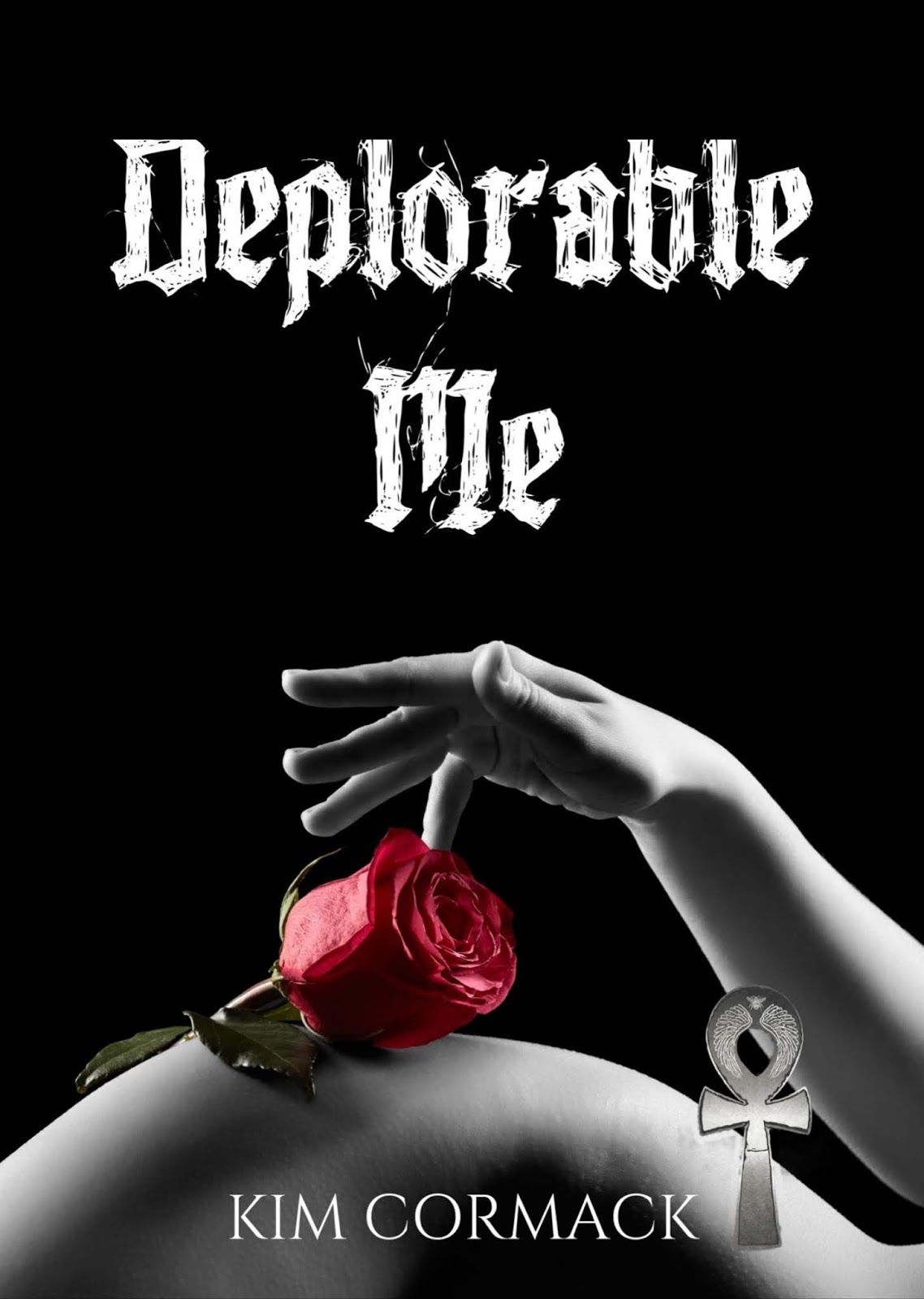
Deplorable Me

Children Of Ankh Universe Middle-Grade Novella Series
Bring Out Your Dead

I have a middle-grade old school sci-fi book, Mythomedia Press may release as an extra treat this year, The Repopulation Project.

What words, if any, of advice have guided you through your writing life?

It's a marathon, not a sprint. Nothing happens overnight. I'm glad it didn't, I've matured as an author in so many ways over this last decade.

Write with you filter off and be brave. Write about what scares you. Be true to your imagination. I could have dialled the trauma these characters face back or changed Lexy's age at the beginning of Wild Thing to make everyone comfortable but opted to stay true to my imagination. I have an excellent review describing Lexy's character as Unapologetically Feral. I was beyond proud. That is precisely what I was going for. Every piece of the puzzle serves a higher purpose. There's a series quote, Someone has to go into the dark to lead the others out. If not me...who?

I'm in a cover contest. Vote for Sweet Sleep here. https://allauthor.com/cover-of-the-month/6716/

1-800-9378200 customerservice@ingrambook.com

https://twitter.com/kimcormack
https://twitter.com/childrenofankh
https://www.instagram.com/kimcormack/
https://twitter.com/mythomediapress


Just a few series twitter accounts it’s a long list

https://www.goodreads.com/author/show/4456923.Kim_Cormack
https://www.facebook.com/authorkimcormack/
https://www.facebook.com/ChildrenOfAnkhSeries/
https://www.facebook.com/kcormack4u
https://www.facebook.com/MythomediaPress/
https://kimcormack.blogspot.com/
https://www.smashwords.com/profile/view/kimcormack
https://allauthor.com/author/kimcormack/
https://www.pinterest.ca/childrenofankh/


Wednesday, December 25, 2019

Dark and Different Brain Trips

12/25/2019
By Alex Ness

I was asked what comics are there that are completely new.  Since I don't altogether think new is a possible,  

"Ecclesiastes 1:9 New International Version (NIV)

9 What has been will be again,
    what has been done will be done again;
    there is nothing new under the sun." 


I absolutely cannot tell you what comic books you might think are new. I can only think about the world we have and new ideas or outlooks.  These four books consider different and new paradigms than normally found in the world of comics, and whatever your personal outlook these are all worth reading and buying.

However different, perhaps transgressive, there are works that assume a paradigm that is different than most, that rise above purely speculative, and by doing so, make good and relevant use of the many issues facing humanity.

What are those issues?  We live in an era of vast amounts of information.  We have choices to make that involve sexual expression, drug use, violence as both sport and lifestyle.  But we also have to do all those things in conjunction with a world that tries to limit one's access to those choices.  If you pursue almost anything, it is found on the internet, as well as within the world.  Should you choose to eat, drink, smoke, inject, or anything, you can find a way to do so, and do so both legally and illegally.  

The Filth by Grant Morrison and Chris Weston (DC/Vertigo)

The Filth features a world that is controlled by an over arching society if not necessarily government, and the options that someone has within that world.  In the world of The Filth the reader is asked to look at the life of a character who pursues an interest sex and pornography, to a possible exclusion of real relationships. He is a member of a world that is both outside of the normal world, and interested in culture in a manner that asserts an interest in creating by participation in secret societies to create a new society that is postmodern.  Drugs, Sex, Violence, are all avenues of creating a new sort of world, with permissions from individuals to allow society, government and personal agency to revalue the world.  At the time The Filth was released the worst excesses of the Patriot acts and subversion of individuals in a post war on terror world had yet to be seen.  It seems, however vulgar, to be more hopeful that one might have thought possible considering the near future choices Morrison saw as possible in his near future world.

Narcopolis by Jamie Delano and Jeremy Rock (Avatar Press)

The Narcopolis world we are looking into is very much the sort that 1984 by George Orwell or Brave New World by Aldous Huxley would have perceived, and that isn't in any way to say less of it. The protagonist has to explore his world, rights, causes, and eventually rebel from that world. Drugs are used to enhance, to empower citizens and is used to disengage from society.  The society in question relies upon certain ways to control citizens, while individuals are able to enhance or "adjust" their existence by pharmaceutical means, by ability to adjust sleep, to receive surgery or the like.  The world is one where the individual is forced to transgress against society to be allowed to pursue their own path.  This work, even more so than the Filth, looks deeply into our present world,  if you consider the world we live in presently. Data mining, predictive text and AI, the ability to intercept personal data and knowledge by government of individual behavior, surgery to enhance the individual abilities or even to achieve a level of beauty, and drug use by the individuals as well by government to alter lives, all exist in ways that are frightening to consider, but have become deep parts of existence.  While fiction, Narcopolis imagines a world that isn't that hard to consider.


Transmetropolitan by Warren Ellis and Darick Robertson (DC/Vertigo)

The protagonists in the previous two mentioned works, feature both rebels and individuals, but Transmetropolitan features a dystopian world with a reporter who is actually a part of that world, and he looks into it, challenges it, and tries to change it.  It seems far more interested in considering the present than the future, that is to say, the world presented is far less futuristic or science fiction, but decayed forms of the presents aspects of life.  Government, media, and culture are presented as dystopian, but are recognizable in ways to suggest, something not so far way in time or event than this our present. Perhaps there isn't an agency to change the present, but perhaps to show that the present world has masses of people who do not perceive the politics, media and cultural forces that exist and that there are forces that alter access to democratic, free, individualistic existence. The lead character is much more a personal character who the reader sees through the eyes of.


Tokyo Ghost by Rick Remender and Sean Murphy (Image Comics)

The three previous series all considered worlds that were mostly extension of the present issues, government, culture that by being made extreme came further into focus.  Tokyo Ghost was a brilliant deep future consideration where the world becomes addicted to forms of entertainment that stimulate adrenaline and addictions to technology, creating a world that allows few areas with little or no technology.  Brilliantly, it suggests that the evolution of tech is something that is self perpetuating, and evolves due to human intervention, but is beyond human perception.  It only reached 10 issues of comics, and has a collected version, but it remains open to further chapters.


So, whatever you are looking for, I think that are new books to consider, the dystopias presented are all means to consider the world of the near future.

Friday, December 13, 2019

The Kaepernick Question

12/13/2019
By Alex Ness

On occasion I try to go beyond the concepts of media products or interviews of talents here.  I don't say those are bad, but, popular culture includes sports, as in the following commentary, or food culture, and ever changing values and ideas that challenge the mainstream. Challenging the mainstream offers that someday the idea in question might enter our popular ideals, as having been a victor in a free market, free speech, free will society, where the best idea wins the argument. If we do not talk about things, if we erect echo chambers and follow and listen to only those thinkers we already agree with, why talk?  Why bother if the possibility of change is impossible?  We talk to learn, to negotiate culture, we talk to exchange ideas, ideals, and share dreams and nightmares, because if we do nothing, our society begins to decay, for stasis is not a way to lead, it is the path of those who are accepting of being dead or are too ill to realize that they are dying.

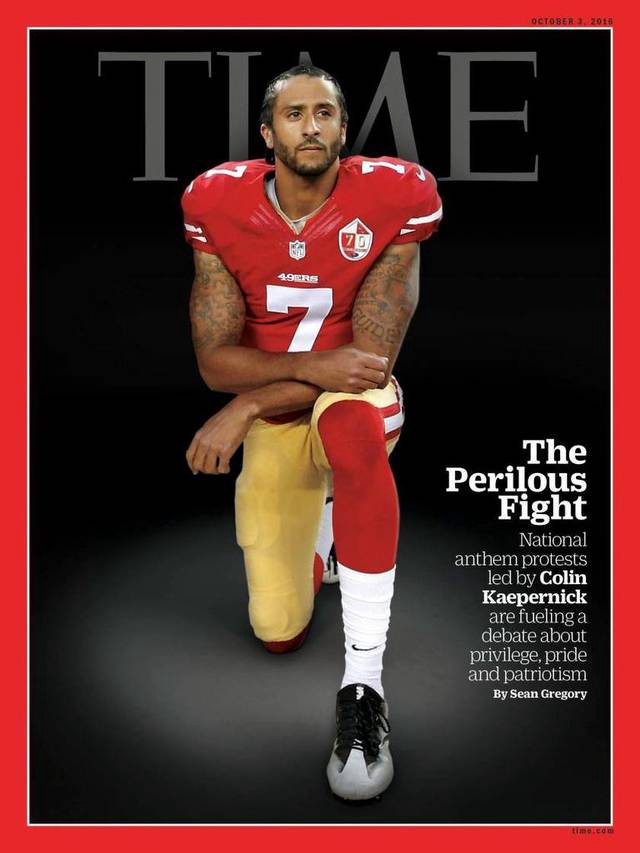
The reason Colin Kapernick began his protest was to bring attention to the problems of police brutality, nationwide inequity towards black people from the US Justice department, and the protest was aimed at changing how people think about the people they watch on the stage of football.  These men are not all just muscles and agility and power.  They have minds and do not agree with the National Anthem, because the country has failed them.

Recently pro football exile Colin Kaepernick was offered a chance to work out for NFL scouts as arranged by the NFL head office.  He saw flaws in the plan, and arranged an alternative event, to showcase his talents.  No one signed him. The NFL has suggested either directly or through channels that the overall product offered by the NFL is harmed by his choice to protest the offering of the national anthem.  Some cynics suggested that his play had seriously declined, and that taking a knee was a means to making his presence more difficult to remove.  Others suggested that his previous career earnings were more than enough to sustain him should his "plot" fail. The worst argument for wanting Kaepernick out of the NFL is to say life is so much better today for African Americans that the act of protest is selfish, false, and attention grabbing.  First of all, it is attention grabbing, that was the point to use the attention to draw interest to the cause. Many people were pissed off by it, that too, was the point.

So did his plan work?  Did change happen as a result of his protest, and was he able to be redeemed by the changed world and raised aloft to return to the NFL?  No. It is also categorically wrong to suggest racism does not still exist, hasn't existed throughout the life of the NFL, and that enough has been done to stop it.  He couldn't stop the continuance of such behavior, and his protest didn't change enough minds to do anything.  But does that make him wrong? I'd agree that it does seem foolish to see African American athletes raise the specter of being slaves upon the plantation.  Millionaires have far more choices than those poor, black or white.  That is called hyperbole.  It is also false that there is any connection between the protests and improvements in the situations regarding inequity and outright racism.  But if John Brown had attacked Harper's Ferry only to die, and not achieve his goals, it doesn't mean he failed.  His legend lived on.  In Japan there is a cultural concept that sincerity makes any attempt to change or fulfill the task given, already worthy.  Rebels do not often succeed.  Because they die in the attempt should we say it was wrong to try? If Martin Luther King had not led a movement, would blacks have the vote and power to use it, or would the Jim Crow laws be unchanged still, without his effort, and ultimate sacrifice?

I promise you, I am made uncomfortable by people who think patriotism is foolish, or that love of country is silly. I don't like flag burning. I don't like a number of speakers for the movements of various causes.  But I like the fact that those who fought in wars because of the love of country did so knowing that the end result might be someone burning a flag.  Many believed in free speech and part of that freedom is the freedom to hear opposing viewpoints and not kill the person speaking those viewpoints.  We live in a world where it is FAR easier to walk alongside of people who are not protesting, who are being well paid, and who prefer no one else to rock the boat. Nothing different happens without something, someone or many things changing course. We live in an era where we had Obama, a good man, a President I voted for, who stands to some as a living symbol of the final victory over systemic racism.  I say no.  He was elected for good reasons, I think I have issues with most presidents so I am not going to jump up and down saying I loved his choices.  We are not seeing the end of a revolution.  We are seeing a moment in time that defied the traditional ways of thinking.  As someone who did analysis for a political non profit organization, I believed in Obama, but believed something that had never happened would have to happen for him to win.  And he did.

As a result of his victory we do not thereafter find an African American dominance of politics.  Nor do we yet have equality over all for all people in America.  You might argue the reasons for that, it isn't going to happen here. My point is, we, as a whole people, Americans, haven't made things that much better nor have they been willing to change. Kaepernick is protesting, or was, the true situation, as well as perhaps being used by some to create a movement that his causing waves might be able to take advantage of that person or group.  We have failed to make America the home of righteousness, of hope, of being fed, or being happy.  We have allowed some but not all to do that.

And as I go, remember, just because slavery ended, it does not mean inequality ended as well. There have been race riots in this country, and I refuse to believe that because it is comfortable for me, that it is similarly so for others.  That isn't the truth.