Sunday, May 9, 2021

In the Glow of the Completion of Interview week

MAY 10, 2021
By Alex Ness


INTERVIEW WEEK

I have to say thank you for the many people who responded to my request for interviews. The answers given were very interesting to me, and the time spent by every person participating was appreciated by me, and will forever be considered a gift of time and attention that I'll not forget. As my health issue that originally was the reason for the event changed and the surgery postponed until later, I still have issues, but I deeply appreciated the effort and time given to me by others. I don't have a clue at this point when the original surgery will be rescheduled. Covid sucks massive dick.

Let me say thank you in a direct way. To Michael May, Mike Carey, Diedra Drake, David Hine, Kim Cormack, Clyve Rose, Jason Peters, Erik Larsen, Nate Barlow, and Tyson Allison, I wish to express my deep thanks, my appreciation, and manifest best wishes for your success in the future works you release. I'm humbled to have had your attention for the amount that I did, and I do not see it as free, nor as given without cost. Thank you.

REVIEW

RELIC
ALAN DEAN FOSTER
Mass Market Paperback | $7.99
Published by Del Rey
Mar 26, 2019 | 400 Pages | 4-3/16 x 6-7/8| ISBN 9781101967652

(I bought the book being reviewed, it was not provided by the publisher.)

In this world it seems that the human race has come to a final survivor of a final extinction event. But rather than a morose accusatory screed, Alan Dean Foster weaves a tale of love, hope and a future. In this story aliens play a role in human evolution, or, rather human survival. This book reminds me in parts of Mary Shelley's The LAST MAN, 2001 SPACE ODYSSEY and the wonderfully powerful movie INTERSTELLAR, so it has a hold upon some truly powerful themes. And since we've heard for the last 30 years that humans have caused global climate change, that they've polluted the deepest reservoirs, stolen a future from our children, a work like this could be dark as hell. (Or even worse than dark, we've even had scientists suggest this generation will be dead before the end of the 2030s.) The reason this work is so powerful, is that in the species extinction, Foster finds a way to reimagine the end, and give humanity hope. I am a fan of Alan Dean Foster, yes. This work goes beyond my appreciation of his writing and ideas, it made a deeper impact for me because of the power of hope he offers the reader. I had tears in my eyes, and at the end of this f-king pandemic, it was a source of comfort, and beauty.

REVIEW

 ODIN By Aaron Kerr

As some emailers have noted, I have become highly enamored of the work of Aaron Kerr, and his various associated groups and projects. When I met him at a bookstore I love, I was taken with his clear intellect, and worth as a human. Eventually that in person meeting turned into a large, really good interview. I am an introvert, to the extent that it actually interferes with how I deal with people. There are people I've met who I know would be amazing to get to know, but never go beyond a smile or kind hello. Over time he and I would trade his music CDs for my poetry books.  To say that I was humbled to make the exchange would be an understatement. I vastly admire his creative talents, and to be "sanctioned" by a sort of equity of esteem for the other, moved me far beyond my ability to express.  

But beyond the exchange, I can tell you that there was something in the music that I couldn't express what it was, but it lingered, like an echo, or a scent in the air that reminds you of a moment in your life, and the moment wasn't remembered for an event that was bad, it was a moment you want to linger in, to remember, to allow this music to continue to evoke in you this place and time. Much of Aaron's work that I had listened to didn't have lyrics, and, while I know people who tell me that instrumental is an exalted form of elevator music, this was quite the opposite.  I was able to revel in the good things, and banish the bad or sad thoughts from my PTSD affected brain.

Then, when I chatted with Aaron about his projects, I realized, we have very similar interest areas. And the exciting thing about that, is that when you meet someone you respect, perhaps in awe of their abilities or perhaps not, discovering that they read about the same things, research, for any purpose the same subjects, leads you together down a path. When I was moving from my grad school era apartment in Fargo, back to Minneapolis with my wife, I'd run into one of my favorite professors at Walmart or Target. She was with her significant other, soon to be her husband. She introduced us, saying, Hey Alex, this is my significant other or boyfriend or whatever term she used, and Patrick, this is Alex Ness, And he is moved in ways we are moved. What she was referring to was an ethic of life, and view of worth of all people.  As well as outlook, areas of similar interest. But the reason I mention this, is that she was far left, and I was a-political.  It moved me to tears afterward that she saw us as being similarly moved, because to me, in the words of Deng Xaioping, It matters not the color of the cat, so long as it catches the mouse. We can debate or discuss anything, but usually wherever you end up, people on the journey have their own path to follow. This constant, of the path being different, doesn't make either person's path wrong. With Aaron I realized we had the same interests but have perspectives about the subjects, that are, almost certainly, very different. For me this is always an opportunity to learn.

When I realized I had views I wasn't happy to have, I prayed to God to give me reason to change. And shortly thereafter, I experienced people from every area of life who I was troubled by.  When I was 15 and called friends Communists, I was insulting them. I had became convicted in spirit by a very moving story I'd read of a person growing up Soviet, and the troubles they had doing so. I began reading about the world of the Soviet Union. By doing so I had developed respect for the revolution and system, however flawed it might be in practice. Over time what I've done, is that have I chosen to have the people in life be teachers so I can understand more about this existence. And more than tolerance, I want to accept every person who exists who is not evil. Tolerance is the bare bones of my existence, whereas acceptance gives me a vast number of reasons to hope and find reason to endure.

Listening to the music of Aaron Kerr fills my spirit with hope. And with his work ODIN something more was going on than the spirit of the music. As it begins there is a single sound, an unique voice of an instrument, and as it proceeds there is a process of adding instruments and sounds, by such adding layer after layer of meaning, as well as adding context. Should you listen to Wardruna or even metal bands that evoke a Viking sound, there is a driven content, like the winds that carry the ships to the enemy shore, or the power and fury of the lightning in the God Thor's hammer. This is entirely different, without being less powerful, or less meaningful.  By subtle construction of the layers of music, there is an impact, and by the power and rhythm of each song, there is a message being told. The meaning comes from the emotion packed deep in the sound, in the constant interaction with the listener. The meaning comes from the mental images created by the power of the sound.

As a person who has written hundreds of Viking era poems, and have had them published, it should become clear, that I am a fan of the subject. But beyond my own personal interest, I have learned that I have Viking heritage in my DNA. In fact, I am 95% Vikings, mixed of Swede, Norwegian and Baltic/ Northeastern Russian. So, I confess, I think it is possible that the reason this work moves me is that is flows through the memories of my ancestors.  I do not know that this is possible, but it feels so. This brand new work by Aaron Kerr is powerful, and I feel it in me. It is good. And more so, his music heals me.

3 AUTHORS & 4 BOOKS I LIKED THAT THEY WROTE

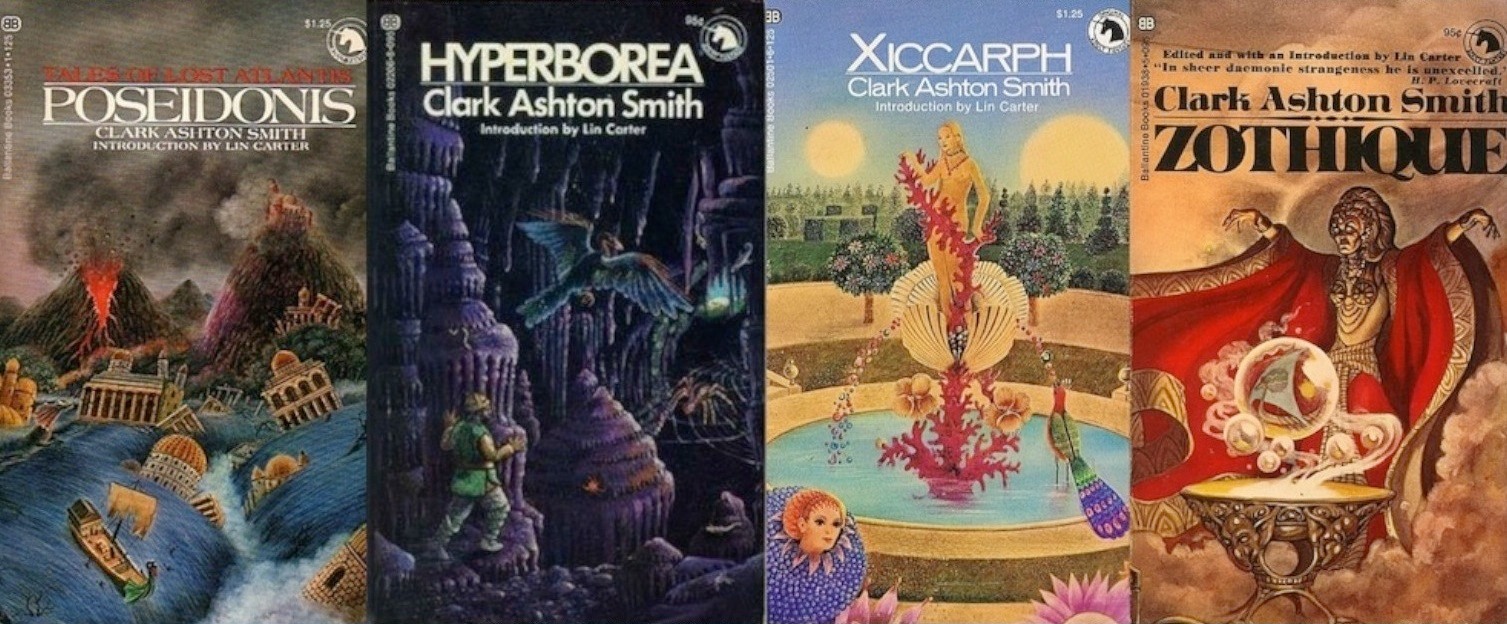
I am a fan of a variety of talents in different areas.  This will be a small feature where upon giving you a small blurb about an author followed by an image of 4 books they wrote that I enjoyed. The 4 books are shared as suggested points of entry to that author's work. I'm not actually saying that these are the best of that author, more accurately they are books I really enjoyed.  Some names will be familiar to you, but others will likely not be. I don't mean this to say these are the only great writers, obviously.  Just to offer a taste and why I do like them.

Clark Ashton Smith

I've heard that modern readers don't find themselves moved by Clark Ashton Smith's writings.  If that is true, I am not modern.  Upon reading my first Smith work I said to my self, this is a writer who is writing for me alone.  His various outlooks, varied interests and ways of expression are in my taste zone. Add to that the mythic content he delves in, he is probably my favorite writer.
Robert E. Howard

In terms of writing skills and his presentation of an idea, and in his the purity of word, Robert E. Howard works for me in ways almost no one else does.  His characters, however drawn, perhaps have similarities, and they exist in a universe less developed as hewn from stone, he writes nonetheless solid tales. 

Edward Plunkett, 18th Baron of Dunsany, Lord Dunsany

In the ways Ernest Hemingway, Robert E. Howard and Truman Capote evoke using economic phrasing and construction of sentences, Lord Dunsany is the opposite.  His lush sentences, his word use, his construction of an aesthetic, ethos and universe, makes him a master of the word.  Some modern readers might see his writing as complicated or heavy, it works for me because it is so rare, so beautiful, that I am able to relax and dream with his voice narrating my dreams.


ABOUT GETTING REVIEWS FROM ME

First off, I can be found on Facebook, Twitter or through email at Alexanderness63@gmail.com. I accept hard copies, so when you inquire at any of these places, I'll follow through by telling you my street address. I no longer have a post box, although I regret that.  It was a crushing defeat to no longer have a p.o. box, when I came to realize I was getting so little product it made no sense to pay for the privilege to not receive mail at both my home and at the post office. If you send hard copies for review I will always review them, but if you prefer to send pdf or ebooks to my email, I will review these at my discretion. I don't share my pdf/ebooks, so you can avoid worry that I'd dispense them for free to others.

My Amazon Page Amazon.com/author/AlexNess
My Poetry Blog alexnesspoetry.blogspot.com
My Published Works alexnesspoetry.blogspot.com/2007/01/My-Work.html
Lovecraft Horror cthulhudarkness.blogspot.com
Lost Worlds alexnesslostworlds.blogspot.com

Thursday, May 6, 2021

A TALK WITH Creative Artist and Record company Publisher: TYSON ALLISON

I interviewed Aaron Kerr about his work, and that led me to a wonderful odyssey of finding the band the Swallows, Dissonant Creatures, and J. Briozo, Sleeper Pins and more. The label they are published by is Emperor Penguin Records, and the label is run by Tyson Allison. He is also aboard the bands mentioned. Through the quarantine I endured a vast number of health issues and worries. But, rather than fall into deep depression, I was moved and lifted by the beauty of this music. I felt that I had to interview Tyson, as a desire to inquire into a creative mind, and as a way to find out how I could help promote such magnificent music.

Alex: Tell me first of all, where are you from, where did you go to school, where do you live now? Does the sense of local and the region you come from infiltrate your work?  How so?

TYSON ALLISON:
I’m from Grand Forks, ND.  I was largely raised by my Mom, as my Dad died in a snowmobile accident when I was 3 years old.  We lived there until I was 11, then we moved with her boyfriend (who later became my Stepdad) to Mountain Home, ID. It was beautiful, mountainous land and although we lived in a very small town, I actually really enjoyed my time there.  When I was about to turn 15 we moved again, this time to Racine, WI.  My Stepdad was from there and had a lot of family there. I spent all of my high school years there, which was tough at the beginning because I didn’t really know anyone there. My Mom, Stepdad, and 2 half-sisters still live in Racine now. After I graduated, I went to college in St. Cloud, MN and later moved to the Twin Cities with my girlfriend. We got married and had our son Eli.  Several years later my wife and I divorced. She returned to Racine, WI where she was from, and I was able to stay with my company and transfer to Chicago in order to remain close to my son.  It soon became apparent that Chicago wasn’t close enough; I wasn’t happy and felt I wasn’t seeing my son enough, so once again I transferred and made my way to Milwaukee, which is about 30 minutes away from Racine.  I’ve been in Milwaukee now for 9 years and have remarried and established some roots here.  

Throughout most of my life I’ve been an avid music lover and musician.  I’ve been in several bands, produced/recorded albums, booked shows, toured regionally, and started my own record label called Emperor Penguin Records. There are many factors and experiences that can shape an artist’s work.  I do believe that locale is one of them. When I listen to bands like the Yeah Yeah Yeahs, or Sonic Youth, I can hear NYC oozing out of their music. The art scene, the frenzy, and the confidence that helps them stand out from the other millions of people around them.  My friend and collaborator Jeff Crandall is from the west coast, growing up in both Oregon and California, and I often hear tones and motifs that I would associate with the ocean and the sun coming from his music.  

For me, obviously I’m influenced by “the midwest.” I’m a sucker for alt-country bands like the triumvirate of Uncle Tupelo/Wilco/Son Volt.  A polite disposition, strong work ethic, and appreciation for well-crafted things is always part of me.  (But I’m also charmed by the drunken middle fingers to all that in bands like the Replacements!)  We feel all 4 seasons here, and I gravitate toward the “darker” side of them—cold, slushy winters and wicked summer thunderstorms.  But there is a beauty within them and on the other side of them that I also enjoy.  My favorite season is Fall, where you don’t need a coat to go outside, but you may need a flannel in the evening.  It’s nice, but there’s a bit of a nip in the air, and you can smell a bonfire not too far away.  That’s my music.  I like wide open spaces, and don’t like a lot of clutter in my music.  I feel lucky to have moved around in my life.  Part of my life was spent looking out my window at another concrete building, and part of it was spent looking at a mountain.  I’ve been exposed to country life and city life.  “Three Chords and the Truth” and “Better Living Through Noise”.  Both influence my music.  It’s why I’m just as comfortable making an acoustic album of conventional song/lyric structure as I am making an experimental record of wild improvisation. And I like it that way.

Alex:What is your training, outside of all the playing you do which is practice after the original training. Do you think music is a gift  you naturally possess, or does it require nuanced efforts to expose it to light and act upon it? Norm Macdonald once said that comedy isn't about being naturally talented, because funny people can go on a stand up stage and if no one laughs, they weren't measurably funny.  Therefore it is a skill you learn. Is making music similar?

TYSON: I don’t have much official training. Sadly, I am one of those many musicians that largely learned by ear and experience. Although I can read chord charts, I am terrible at sight reading and have only a basic knowledge of actual theory.  I did receive some guitar lessons at three different points in my youth; all of them were short-lived and in the grand scheme of things didn’t help me all that much. For drums I followed a few instruction books to get started and progressed from there, and the rest of the instruments I play (bass, piano) I just figured things out as I needed.  Part of me is fine with this situation, but the other part of me is disappointed that I didn’t go through formal training with music.  It makes me feel like I’m not a “real musician”  at times, or that by calling myself a musician I am disrespecting those that did go through all the training with theory and sight reading and truly learned their instruments. I am in awe of these folks that can have a piece of music they’ve never heard or seen before put in front of them and they can play it.  For the most part I’ve made my peace with this and accept that I take the skills I have and use them and continue to build on them. I make music, therefore I’m a musician.  It took me a long time to get to a point where I was comfortable saying that!

My friend and collaborator Aaron Kerr, who is steeped in theory and a virtuoso on cello, told me that he likes the fact that my knowledge of theory is limited; he said it lets me take chances and frees me up to find melodies and chord structures that in theory don’t necessarily work. This kind of thing interests and excites Aaron as a player, and allows him to also think outside of the box of theory to find a way to make these musical ideas work. This has all proved to be very beneficial to our songwriting relationship. So whether or not there is training to cultivate it, I do think that music is something that comes natural. The steps that happen to facilitate a person going from novice to pro musician are things that would unfold naturally just by being in that context.  I think people have a compass inside of them that points them in the direction of things their heart would be happy doing.

There can be several different paths to sort out, so perhaps not all of them get followed, but something inside of us is saying “you should do this” because we inherently know we will like it and (hopefully) be good at it.   We often hear of people being called a “natural athlete.” It’s the same kind of thing. Some people were just born with the coordination, motor skills, body control and calculation to be good at sports. Some aren’t. Some people get naturally drawn to melody, can whistle or sing in tune, and will find their way to one or several instruments and learn to play them. Some don’t. The funny thing is that sports, music, and all forms of art are there for all of us if we want to give them a try. It doesn’t matter what we’re born with to take the initial step; we can all do them to some capacity/level or another.  But I do think there is some magic in the DNA that’s involved that will help some people exceed and expand while others plateau early in the process.  Passion, drive, and positive/negative feedback come into the picture as well.  Some musicians learn an instrument but never create original music.  Others create original music but it’s on top of another musician’s creative blueprint that was made first.  

I’ve met many great musicians that would never feel comfortable writing song lyrics and are happy to let others handle that side of the process.  It’s all different levels of involvement and it’s all useful; we all need each other and work off of each other.  Happiness and fulfillment can be found at any level.  In my case, I’ve always gravitated to music. I was singing, learning lyrics, and paying attention to the radio long before I ever played an instrument. It physically affects me.  It can rearrange my chemistry and change my mood.  I feel validated when I play music, like nature is running its course and I’m doing what I’m supposed to be doing with my life.  I hope everyone finds that thing that makes them feel that way, whatever it may be. My son currently doesn’t play an instrument, but I’ve noticed his built in sense of rhythm.  If he wants to I believe he could be a good drummer/percussionist.  I used to work at Music Go Round and sold tons of guitars to people in their 50s just starting out; they were happy to learn some cover songs and play around the house.  And they could grow from there, it’s never too late! I know plenty of people that don’t play anything but still appreciate music and love to listen.  It’s up to each individual person how far and at what point in their life they want to follow their compass.  

On the whole, I disagree with Norm MacDonald’s quote. I think comedians do have natural talent; they are often great storytellers, have a unique way of looking at the world, and don’t mind getting up in front of people to  succeed or fail.  None of those characteristics are necessarily teachable, whereas music theory and some level of performance can be taught. Comedians work on their craft of jokes/bits/observations as much as musicians work on chord structures/melodies/lyrics.  Both require work to achieve greatness, and some performers are going to begin higher up on the ladder than others.  I realize that Norm said comedy isn’t “about” natural talent, but the source of motivation to even get oneself onto a performance stage is something that likely came naturally to that person in the first place.  If a comedian doesn’t get laughs, then they weren’t funny for that particular show for that particular crowd. But there shouldn’t be a blanket statement made about that comedian.  The natural gifts that a comedian possesses will propel them to get up and try again for another crowd.  Here’s where comedy and music are definitely different, though:  the interpretation of feedback.  Performers need feedback.  It’s a barometer as to how we are doing and how pleasing our art is.  It answers the question “Do you like what I do?”  Comedians are looking for laughs.  Musicians are looking for applause.  The only way to get it is to put material out there to an audience and see what happens.  For comedians, people either laugh or they don’t.  Laughter is an elicited response, so something is either funny or it isn’t.  The audience won’t “fake” a laugh; it’s not authentic and wasn’t earned. So laughter is hard evidence that a comedian can interpret as success.  

This concept doesn’t carry over to musicians so much; it becomes a gray area where applause as positive feedback is concerned. When bands are finished playing a song at a bar, people clap. Society is conditioned to do this although many of those people weren’t even paying attention to the music; they were drinking and talking to friends or chatting up a girl. I’ve had my fair share of this experience.  I’ve finished playing a song, and there’s a pause while some of the audience realizes that it’s quiet in the room because the music stopped and they start absent-mindedly clapping for a few seconds. They don’t even know what they are clapping for, it was just a response because that’s what they are “supposed” to do. There was no judgment contained in the applause. As the performer, I don’t zero in on these people, I just accept the applause from the audience as a whole while preparing to play the next song. It’s a few seconds of gratification, but really, I don’t know if they actually liked the song or not. Musicians get “fake” claps all the time, so we can’t trust applause as a measure of success. If a comedian doesn’t get a laugh, they know they have to rework the joke or come up with new material.

Musicians get applause no matter what, and we keep playing the same songs in different bars to different crowds, hoping some of the applause is genuine. Perhaps record sales is the only hard evidence we get from someone truly liking our music. A significant portion about modern popular art isn’t about talent anymore; it has become more about what you look like, how savvy you are with social media, and how big of a public spectacle you are willing to make of yourself and your art.  So hell, maybe Norm is right after all.

Alex: Are you one of the many creative talents who has many outlets to demonstrate his or her gifts or skills? How do those, if they exist, intertwine and express themselves with your musical talents?

TYSON:
The human brain is powerful!  I definitely am a believer in the mind/body connection and the physical manifestations that can come from mental thoughts.  I’ve made many scary mountains out of harmless mole hills, and thought myself into and back down from panic/anxiety attacks.  This is a fascinating part of our nature; that we can think of something that becomes real in our bodies, or affects us physically, and I think it’s the same process that allows us to think of something that becomes real outside of our bodies, too.  Like an architect envisioning a design for a skyscraper and then building it in reality down to the last detail.  Our bodies are amazing conduits for ideas becoming reality.  We’ve all got gifts and talents we bring to the table, and they are unique to each of us.  A few of mine that have carried over to music are the hand/eye coordination and motor skills I developed while excelling at sports in my younger years, which has helped me to physically play instruments, and another is the decent mix of left brain/right brain skills I have.  I don’t think either side is dominant for me.  I’ve always had a healthy playground of an imagination that stays busy coming up with ideas, sounds, and various creative projects.  I’ve also always been good at problem solving, math, and analyzing scenarios from multiple angles to find the best step by step plan to make something work.  This all comes in handy when making concept albums, scheduling shows, planning tours, communicating with other artists, and seeing a project through from beginning to end.  

But the outlet I use the most in tandem with my music skills is writing.  I’ve written some stories, had a few poems published, and always have a couple ideas for a future novel, screenplay, or memoir on the back burner.  I’m not a big talker, but there are worlds of things going on in my head that I mostly keep to myself.  Sometimes I’d rather write than speak, and I’d rather read than listen because something about words on a page sink in with me deeper than just hearing them.  I’m drawn to words as a means of expression, and I use them to describe things and feelings in order to get my point across in a way that is both understandable and decorative.  I bring this into my music when attempting to write lyrics.  I’m usually not a fan of meaningless /throwaway lyrics, so I probably put more effort into the words vs. the music in my songs.  I don’t really get tired of my own songs because they all mean something to me personally.  I approach songwriting the same way I would with a poem or story.  First I come up with a concept, then I flesh it out by answering some questions:  Why do I want to write this? How does it make me feel? Where do I want to go with it?  How can I get there?  It’s kind of like a journalistic who/what/when/where/why kind of thing.  The answers to those questions will go a long way in shaping the song, and the rest is a trial and error of details and fitting words with melody. 

One way I’ve found for writing skills to intertwine with music skills for me is that I usually feel pretty confident that I’ll be able to bridge the gap between idea and expression.  If I have a concept, I know I can find the words to describe it, whether by adjective, metaphor, simile, hyperbole, etc.  If I hear a sound in my head, I can usually produce it by tracking down the instrument that resembles that sound and figuring out a part from there, whether I “play” that instrument or not.  In both cases, I’m using tools that translate nicely between writing and music.  Through this, I’m able to hear whole songs in my head even though they haven’t been played yet.  I get a pretty clear picture of what instruments I want in it and a rough idea of many of the parts as well.  My love of reading has given me an appreciation for words, and also a cinematic mind.  If I’m reading a book, I’m also making a movie of it in my head.  I use this same concept with music, except it’s sound instead of pictures.
 
Alex: I've not met a musician who hasn't listened to many hours of music by other talents.  This isn't asking your influences (Ok maybe that is coming soon) but, what genres and creative talents  have you informed your musical mind by listening to them?  If a talent was exposed to a new form of music,( a classical talent first hearing rap, or a heavy metal fan is exposed for the first time to opera) does it naturally influence their own work, or are your enjoyment of a genre for your inner development and not one that will change your course of expression?

TYSON: Most of what I listen to falls under the large umbrella of rock music. Of course there are sub-genres of that, and I would say that I lean toward singer/songwriters, indie rock and instrumental rock artists.  I like well-crafted music by artists that take the time to infuse their music with imagination, feeling, visuals, and mystery.  The longer it takes me to come up with whatever my interpretation of the song is the better. I’ve got open ears, and also listen to plenty of jazz, experimental, country, and rap/hip hop music as well. Modern and from the past. All of it offers something up to me, and all of it has elements I can use in the music I create. Artists like Brian Eno, John Zorn, Explosions in the Sky, and Mogwai were eye openers on the experimental/instrumental front, and now I’m happy to say that I’ve been a co-creator on 4 albums of that nature. No matter what genres or the number of artists I’ve listened to, the ones that have informed my musical mind the most have one thing in common: the music they make now is nowhere near the music they made when they began. They did this by pushing their envelopes and growing as artists, challenging their listeners to follow along. Artists like Radiohead, Tom Waits, the Beatles. Bending genres, finding new sounds, making us scratch our heads while we figure out their new direction. When they do this, I don’t question the artist as to why they “went there”, I question myself as to why I don’t “get it”.  Some of my favorite albums are the ones I was disappointed with at first listen, and then a year later I think it’s brilliant.  On the other hand, my attraction to singer/songwriters isn’t because they continuously change their sound, it’s because of their lyrical skills and ability to consistently deliver thought provoking, clever, unique, and/or detailed pictures in my mind.  Artists like Dylan, Prine, Vic Chesnutt, and Damien Jurado to name a few. Whether sonically or lyrically, I’m always looking for artists that inspire me to work on my own craft and heighten it in quality.  In order to achieve that, I feel it’s important to keep an open mind and expose myself to what’s out there.  Even if a genre isn’t my cup of tea, I would never automatically reject that genre.  I would look for the merit in it and why other people like it.

At the end of the day, I’m a musician and it’s just music, so it’s easy to find some common ground somewhere.  After I find my footing, I start noticing what’s going on in a piece and how the musical elements are being used; there are always patterns and rhythm in some form or another.  Is there a melody I can latch onto?  Or maybe the production is interesting, or maybe the sounds are intriguing and not immediately identifiable—I find this interesting.  I think a well-rounded artist or music appreciator should be eclectic.  To be immersed in the sound experience and willing to be influenced.  It doesn’t have to change the trajectory of their own art, but it can be a cool diversion or useable concept to incorporate.  How did Queen get to “Bohemian Rhapsody”? I have no idea, but that’s an example of what can happen when a rock artist checks out the opera.  They fused it and ran with it, and when it came out it was a curveball to their fans, but it worked.  Really though, Freddie Mercury always had an operatic voice, so it shouldn’t have been a shock.  I’ve often seen a correlation between metal and classical.  The complicated keys and chord structures, the speed/agility it takes to pull off those scale runs, and just check out their soloists—their hands are moving the same way and they are making the same faces!  About 90% of the music my son listens to is Rap/Hip Hop, and for a number of years now I’ve been letting him control the radio in the car. I’ve enjoyed stepping outside my wheelhouse to soak it all in, taking note of new production trends and vocal styles. My son pulls up videos for me to watch, and tells me about his favorite artists like Travis Scott and Juice WRLD, and I tell him about Jay Z and A Tribe Called Quest and we have cool conversations about it all that dig into the music business, radio programming, performing, life, etc.  All genres adapt to change, and there are innovators everywhere, so why not embrace them? 

With the current explosion of streaming services, I’ve been watching many documentaries about bands and musicians.  I love the behind the scenes perspectives and real life situations going on with the artist, the tour, and the music industry.  It’s gotten to the point where I even watch documentaries about artists I’m not a fan of because there is always something interesting I can take away from it.  Often when I learn about an artist’s motivations, struggles, background, and ambitions, I find a connection in there somewhere and I’ll give their music another chance and hear it from a new perspective.  Sometimes it’s enough to win me over.  I suspect this would translate over to people everywhere.  If we just got to know a stranger or listened to their story we would let our guard down and care more about them.

Alex: Big picture question here, would a greater focus upon the arts from the earliest age in school necessarily result in more creative people or new sounds? Or would the creative somehow, in whatever format, style or genre find a way to express. Do all seeds end up with a harvest in the area of creativity?

TYSON: Yes, I do believe there would be a higher percentage of creative people originating from an elementary school discovery program. There’s gotta be more kids out there that are falling through the cracks because they are positioned at a disadvantage of some kind. Lack of exposure, support, encouragement, resources, finances, or simply living in an area without creative programs has to make a substantial difference to the number of kids involved in whatever arts do exist at the time they begin their education. I am so disheartened when I hear about schools that have to cut their music/arts programs because of lack of funding. It’s so wrong and I feel for the kids that are missing out. Some kids need someone to show the way and provide creative outlets, as not all parents are able to or are attuned to the possible hidden talents their children may possess.  

The most logical place for a child to encounter these outlets would be school. A teacher may be the only person to notice a natural flair or talent a child may have for art and help them to see it and utilize it. It’s hard to imagine kids not experiencing the enrichment that the arts can bring to their lives, education, and personal growth. Not to get into a nature/nurture dialogue, but I do also think that some kids would find their way to art or an instrument whether they were exposed to it at school or not; the will and instinct are that strong in some. Fortunately, all of the schools I’ve ever attended have offered a decent amount of art in the curriculum. When I was in 5th grade, the music teacher visited all of the students on one day during lunch break. He came into the cafeteria, made a quick speech about music and the availability of his class to everyone interested, and then came around to each of us to have us try blowing into the mouthpiece of a trumpet, trombone, and tuba (I know, this would never happen today! Germs!).  I remember him saying he liked the sound I made when I tried the trombone, but I told him I wanted to play drums.  I started band class that year and continued all the way through high school and into college.  By my senior year I was playing drums and guitar, and almost half of my day was spent in the music room while playing in symphonic band, orchestra, and jazz band.  Although I’m quite sure I would have played something anyway, it was nice to have my school offer music classes and have a passionate music teacher reaching out to all of us the way he did.  I’m sure that was the catalyst needed for some kids that otherwise never would have tried.  My path officially began there and I’m still on it.  

When art programs are cut from public school, it turns them into this niche thing that parents and kids have to seek out on their own. The spark of someone stumbling onto art while in school is gone and left to only those that probably already know they are interested or have parents guiding them to it. Not everyone can afford private lessons or have the time and resources to be self-taught. This means missing out on the fun and collaboration of making art with friends/peers at school and doing projects and presentations together. Now-a-days I have hope that despite the lack of art in schools, kids can still be exposed to art and find many more resources to help them succeed with it.  Many things exist now that I didn’t have when I was growing up.  The internet has provided several ways to obtain info, free lessons, videos to watch, and artistic online groups/communities to be part of.  It’s a lot easier to obtain cheaper or used instruments.  Art supplies and musical instruments have made their way into big box stores.  

Perhaps the biggest change I’ve noticed is the societal shift in attitude toward the possibility of art being more than a hobby.  When I was younger and starting college, I never thought that I could make a living playing music.  That reality seemed reserved for a select few.  I went to college as an accounting major because I was good with numbers and figured being an accountant was a solid career idea.  As I got deeper into the courses, I became aware that I was bored and had no passion for it, while I felt alive and inspired in my English literature and creative writing classes.  So I switched my major to that and satisfied my music love by joining my college choir and starting a rock band with some friends.  I was on the cusp of the “DIY” movement, but it hadn’t quite taken full effect yet in the minds of the masses. Old school thought processes were still in place, where you focused on finding a decent job and your passions were set aside for weekends and “pipe dreams”.  

Now there are way more resources, home businesses, loan programs, artistic side hustles, and the permeating sense of being able to do what you love, be who you want to be, and actually follow your dreams.  Do your thing, put it on social media, and earn revenue from it.  This concept has carried over to kids and is delivered in books, movies, cartoons, and I think parents have embraced it, too.  The proof is everywhere.  To be clear, I currently do not make my living playing music, but it somehow seems within reach.  Even if schools continue to cut arts, society and technology are providing ways for kids to find it.  But that shouldn’t be relied upon as a way to get it in front of everyone.  Some need to be nudged, recognized, and enlightened to their own potential.  A school arts program can accomplish that, while the benefits of it reach much further than its initial intent.

 
Alex: As a publisher of music you have to look at music in a new way, by interacting with the forces that determine who gets entered into the arts of the culture, who might get paid for work, and who represents you and who you represent. As a writer I understand this because I am a terrible business person. Do the requirements of a capitalist world make you more or less hopeful about music? Does the commodification of art present issues to you?  Why or why not?

TYSON: As a musician, I’m not the best business person, either.  Not in the sense of handling money and communication and all that, but in the practice of the required amount of self promotion it takes to market my music.  I’d rather focus on the music and creating art, but instead more work has to be put into the business end of it.  It’s hard to make it all work being independent and without financial backing. Plus I feel like I’m bothering everyone I know all the time with all the social media posts, pictures, events, invites, etc.  

A few projects I’ve been part of have received professional promotional backing, but it’s expensive and only lasts a short amount of time.  But it does help to spread the word with radio spins, reviews, articles, and you just hope those things translate into more exposure and interest garnered for your art. Sales and money in your pocket. I am no different than most artists; my goal is to do my art for a living and I dream of being able to quit having a “day job”. I don’t need to be rich/famous, I just want to make a living doing my passion. I don’t want a hand out and I’m not lazy. Art is hard work, and the deeper I’ve gotten into the music business the more I know that everything I need to be doing to create, promote, perform, and support myself is easily the equivalent of a full time job.  

So artists are constantly in this state of working their day job while trying to find time to do all of the things their art needs to thrive.  Plus we have all of the other life things to do with errands, bills, groceries, and many are in relationships and are parents, too.  A lot to juggle!  I often wonder what other songs I would write, albums I would make, and how much more I would grow as a musician if I simply had more time to do it.  I’m also in the unique position of trying to run an independent record label, so not only am I trying to do everything for myself, but I’m also trying to help the friends/artists on my label, too.  

From my perspective as a musician, capitalism is squeezing the music business in an ever-tightening choke hold.  Most music is heard digitally now, and the largest platform, Spotify, pays less than 1¢ per stream. CDs barely sell anymore, and producing vinyl is very expensive. Bars expect bands to play for free beer, and there’s someone asking for money from bands every step of the way from forming to recording an album.  It’s actually changing the landscape of artist development.

I’ve noticed way more solo artists emerging instead of bands, and a lot more music created on electronic instruments and computers rather than traditional instruments. I believe this is because of a few things: it’s easier to manage yourself than to manage the lives and schedules of multiple people, you only have to split the money one way, it’s easier to self-promote yourself, and technology has made it convenient to make quality recordings right from your own home. We’re all having to concern ourselves with finding multiple revenue streams via online promotion. There are a lot of scams out there, bots making fake connections, filters to change your appearance, and platforms giving you an uphill battle with algorithms just to make the thing you joined them for work. It’s all smoke and mirrors, and detracting from what you came to do in the first place:  make music.  

The capitalist world is not setup for art and does not support it very well.  Like many things, there are a select few that have massive success and the rest are struggling.  In the current state, I am less hopeful for music in our capitalist society, and I do take issue with the commodification of art. Making art a commodity stifles creativity and narrows what gets presented to the world.  It places artists in the tough position of having to consider how well their art will sell.  Over time, the majority of what is being made begins to conform to only that which is popular, leaving the truly original, unique, new expressions to fall to the side without recognition or not be created at all.  And then what is popular is copied and reproduced in a formulaic fashion until it is completely played out.  Record labels did this with boy bands and grunge in the 90s/2000s. In an effort to make money, the industry even did the lowest of the low—marketing fake performers because they were younger/more attractive than the actual musicians that recorded the music (Milli Vanilli and C+C Music Factory).  In lieu of getting paid, artists can try to get grants, but even that is an unfortunate situation where a committee has to decide which artist is “more creative” or “more deserving” of another.

In a capitalist world, artists are pressured to professionalize, and if they have any success with something they feel like they have to keep remaking the same thing instead of branching out.  Only after something is exhausted are the masses ready to see something new, then the cycle repeats.  This is not a sustainable way for a true art scene to exist.  There will always be visionary artists creating new things, I’m not worried about that, but if they aren’t supported it gives less reason for others to follow their path in the future.  I don’t think art will ever die, but it could become endangered.


Alex: What are the role of arts in modern life? Poetry has served as a cultural gathering place for millennia, acting as entertainment as well as a way to inculcate into culture the events and ideas into a society. Is that still the role of arts? With streaming and digital both strip mining profit and making works still popular but without reward, can the modern society somehow reward without violating their ideal of everything being free for use? How so?

TYSON: Art has a broad definition, and its role in modern life is equally multi-faceted. But ultimately I think it has 2 roles: to make you think and make you feel. Maybe I can boil that down even further to one role: art is a catalyst. It is made to mirror the heart of a person and the soul of society in order to inspire movement.  It speaks to us and for us. For these reasons (and many others) I first want to say that I don’t necessarily feel that art should be free for use. Art is one of the last frontiers for showing us something we’ve never seen before. It originates in the mind, where all things are possible.

A creation with that much potential and bearing traits of one of a kind status is probably worth paying for. When it is free it becomes taken for granted. And that is where we currently are. All forms of art are surrounding us everywhere we go, and we’ve come to expect it to be there. If it’s always supposed to be provided, how do we reward the creators to entice them to keep making it and giving it to us? I’m struggling for a practical answer. It’s easy to think that some kind of trade system could work, but not in an everyday, local, rent and utility bill kind of way. It’s not like in frontier times when if you couldn’t pay your tab at the confectionary you traded in a couple hens or a cow instead. I don’t see the energy company keeping my house warm because I wrote them a song about how cold it is in the winter. On the other hand, the band Weezer once wrote a jingle for State Farm Insurance; for the sake of argument, let’s say in exchange for that song all the members of Weezer were given a year’s worth of free car and home insurance. That would be a solid reward for a mutual exchange of service. Maybe an artist could pay for a hotel stay by painting a picture that could hang in that hotel room. It’s not impossible to think up these scenarios on a case by case basis, but it’s not easy to put it into motion on a large scale for all artists in the day to day real world. It’s hard enough for artists to assign a monetary value to their work; in a trade system they would have to figure out some kind of intrinsic value, which seems like it would be even more difficult.  

There are foundations and charities set up for art in our society, but is that really a reward? And then there are Patreon accounts, where people pay artists each month a certain dollar amount for the privilege of gaining access to exclusive content from that artist that isn’t made available to the general public. That’s been a helpful invention that is gaining popularity and supporting many artists at all levels. I’ve thought about doing it myself. But it also smacks of those commercials on TV that said, “for just 30 cents a day you can sponsor a starving child and provide them with food, clothing, and medical attention.” Is that where we’re at with art in modern life? Apparently.  The really sad thing is that there are artists with Patreon accounts that are actually professionals that have already “made it”. This isn’t a knock on them, I’m just saying that even they need help in this current climate, so where does that leave the local musician that doesn’t have the reach that fame affords?  Asking their relatively small circle of friends and family (that are likely just as financially stretched thin as they are) for support won’t get them very far. I’m not really sure how to make it work, but I do think it is somehow possible for our society to reward artists after appropriation. Whether it be larger scale versions of pay it forward, donations, providing resources, or trade service for service, we as a society need to be more creative with finding ways to show our appreciation for art.  Not everything is about money, but an art gallery isn’t a flea market; you don’t haggle on the price.

Alex: Do you think there is a highest form of music?  That is, I've heard some famous musicians and/or composers say directly, that classical music is the highest form of the musical art due to the many layers, skills and education needed to produce such work?  (I both heard them say it in radio or podcasts, or read them say it in an interview or prose article).

TYSON:
I don’t think it’s necessary to make judgments like that.  I’ll concede to classical music probably being the most complex, but “highest form” is up for interpretation and too dependent on personal taste and the ear of the beholder.  I consider a singer/songwriter stepping out to play a song armed with only an acoustic guitar and their voice as capable of achieving a highest form, albeit in a simplistic way. 

I remember being in a music class in college and one day we were discussing lyrics and the professor turned off all the lights and played Bob Dylan’s “Desolation Row”. I was absolutely enchanted, and although there were over 100 people in the lecture hall, I felt like I was alone in an empty room and Dylan was singing directly to me. That song has no chorus, with a repetitive chord structure and melody that never changes.  Some artists have based entirely forgettable careers and greatest hits albums off of 3 hit songs, which would roughly fit into the 11 minute time frame of this 1 incredible tune.  It was never a hit single, but the imaginative worlds each verse creates continues to cast a spell on me to this day. 

If classical music were the highest form, wouldn’t more musicians shoot for that? Wouldn’t it maintain a larger audience? Why can’t I think of any current household-name-level composers active right now? All the modern composers I can think of died in the 1900s, ending with John Cage. I’m talking right now in 2021. Maybe Hans Zimmer? But he writes largely for film and I feel that is seen in a different light than classical composers. Is there no room for a modern composer next to Beethoven, Bach, Mozart, etc on the pedestal? I mean no disrespect to the genre by asking these questions. I’ve been to classical music performances, symphonies, and I’ve played in symphonic bands. I’m aware that neoclassical artists are out there carrying the torch, but the public is largely still listening to new performances of pieces composed centuries ago. It seems to me that if classical were the highest form, it would evolve so current composers would have found a way to exist beside the old masters. If not, have they failed? Nah, better to keep those kind of judgments out of the picture and appreciate the many talents of musicians in all genres, past and present.

Alex: What works of yours would you offer for a listener who hasn't heard you or the music you publish, to get a firm introduction as well as to entertain and make a signature announcement of quality?

TYSON: Currently there are 11 releases on my record label, Emperor Penguin Records.  The label features traditional lyric/chords songwriting with indie rock albums and also experimental/ instrumental albums as well.  In order for someone to get a representative taste of what we’re about, I would narrow it down to three albums:

The first would be our latest release, “In the Shadow of the Seven Stars” by the Minneapolis band Swallows. It’s a concept album about the real life murder of Frances Coles in Victorian-era London. She is a possible victim of Jack the Ripper, and her ghost haunts a witness to the murder and wants him to avenge her.  This is a historical fiction tale, and lead singer/songwriter Jeff Crandall dove deep into research for this record to turn up actual locations, people, pictures, and events surrounding the murder. This is the 3rd album by Swallows, and they hit their stride on this one with multi-layered music, imaginative storytelling, and the highest production level they’ve ever achieved.  The songs are complex, they are a great live band, and we released a couple videos for this album, too.

The second would be a collaboration I did with cellist Aaron Kerr called “To Combat Loneliness: Compositions Based on the Works of David Foster Wallace”.  Obviously a concept album, this was a labor of love that took almost 10 years to complete.  It took that long not only because I was reading all of DFW’s works and coming up with ideas along the way, but also because when we started the project, I lived in Chicago and Aaron lived in St. Paul.  We did all of the preproduction via mail.  I would send Aaron paraphrases of the plot line or character I wanted each piece to be about from a DFW book, and he would write music on his cello, record it, and mail it back to me for me to hear. Then I would figure out what parts I wanted to add to it.  The album is all experimental/instrumental music, so there were no boundaries.  Eventually we got 10 pieces together and went to a studio in Minneapolis to record them. And then I would work on it piecemeal whenever I could get up to MN and afford studio time. I remember at one point not working on that album for over a year! But it’s done now and in 2020 we were nominated for Best Concept Album at the Independent Music Awards in New York City! We didn’t win, but it was a huge honor just to be recognized!

For the third album, if anyone reading this has any patience, I would want them to hear the new album my band has coming out later this year. The album is currently being mixed, and my band is called Cassini Echoes. It’s an indie rock album, with dynamic songs and introspective lyrics and I’m super proud of it! But for now, if the readers can’t wait, I would direct them to the Sleeper Pins album “Keep it Coming Like A Miracle”. That record was from an old band of mine back when I lived in MN and features some of the same players as are in Swallows. It’s a largely acoustic-based album, moody and quiet but pretty, too. It sums up my writing style and production/arrangement sensibilities.
 
Alex: Lastly, and related to the previous question, please tell my readers where to find your work online, social media, amazon, bandcamp spotify?

TYSON: Here is the link to the Bandcamp page for Emperor Penguin Records, which contains nearly all of my work and the artists that I work with: https://emperorpenguinrecords.bandcamp.com

(All artists/albums here are also available on Spotify individually.)

Here is my Facebook page: https://www.facebook.com/tyson.allison.54

Here is my Instagram page: https://www.instagram.com/music.and.tacos/

Here is my Twitter: https://twitter.com/eprmusic

Here is my Reverbnation page: https://www.reverbnation.com/tysonallison

Here is my Emperor Penguin Records page: https://www.emperorpenguinrecords.com

Here is Swallows: https://www.swallowthemusic.com

Here is the DFW Project: https://www.thedavidfosterwallaceproject.com

Here is Aaron Kerr: https://www.aaronkerr.com

Alex: Thank you Tyson.

I think the readers might also enjoy the youtube channels

The Swallows
Tyson Allison
Aaron Kerr's Dissonant Creatures
Empire Penguin Records

Wednesday, May 5, 2021

FILMMAKER NATE BARLOW Interviewed

I have not met Nate Barlow in person, but I have spoken to him on the phone, and he was part of my interacting with Frank Beddor, producer of Something about Mary and author of the Looking Glass Wars.  I viewed and I think reviewed his film with Adam West, and enjoyed it, and have always admired his desire to make film, to understand it, and to pursue it in a way that produces interesting and different content. So, I present to you an interview with friend, Nate Barlow.

Alex: What can film do that other media cannot? Is film the highest form of medium? If so, how so? Do you see film as ever being overtaken in such a consideration? For example, could an interactive video game or reality programming on television actually be able to get more deep in a viewer's mind than a film?

NATE BARLOW: Film provides spectacle, a shared experience, even a uniting one, and does all these simultaneously—all the more so viewed properly, on the big screen, larger than life as film was intended, with an audience culled from across the gamut of society. Other media simply cannot match film in those regards, maybe individual elements, but not the potency of combination. Game of Thrones brought a level of spectacle never before seen to television, but lacked the communal aspect of being watched together in a theater. Online gaming may be a “shared” experience, but I’ve yet to see one, no matter how great the graphics, that so completely transports one to another world as Star Wars. Partly due to the lack of big screen experience, but also partly due to the nature of the storytelling. Multi-threading is a skill in its own, but lacks the power of bringing all story elements to bear in single minded focus.

That having been said, as much as I love film (movies are my first love alongside books) I would not dare call it the highest form of media, though perhaps the one with the highest potential for greatness (again, alongside books). Each form of media serves a unique purpose and provides a unique experience. Film cannot match television in terms of extended storytelling with myriad arcs, but film’s message can be more powerful and impactful in its conciseness and singular completeness. Video games can be shared, but rarely are done so in en masse in a single physical space. It’s the same reason that sports are so much more thrilling in person than on TV. Even if (or should I say when) we reach the point of a fully immersive virtual world unmistakable from reality, since each individual’s actions in that universe affect his or her unique perception of it, we will see a situation involving millions of smaller interconnected personal experiences, not a single larger shared event and the impact that delivers.

Alex: What have you done as a filmmaker to make yourself best able to enter the world of film? Is it by doing, by education, by watching the work of other filmmakers? What films have you personally created or assisted directly in making happen?  

NATE: Watching movies is the single greatest training, for that teaches the artistry, maybe not explicitly, but at a subconscious level. I had the good fortune growing up of viewing many classic movies on the big screen, not just on video. My father taught at Wesleyan University, which has an amazing film studies program, and he would take me to see their weekly movie. Not every week, but often. I cannot stress enough how influential that experience was on me, both on my future art but even on the decision to become a filmmaker.

That is an education that continues throughout life, watching more and more films, whether on the big screen or at home.

My explicit understanding of the artistry I absorbed subconsciously came from a single filmmaking class I had the opportunity to take in college, followed by my subsequent reading on the matter. The actual mechanics I learned working on set, learning by doing, old school, almost apprenticeship style, as was back in the case of the Hollywood studio system prior to the advent of film schools.

I’ve worked mostly in the indie world. A lot of projects, many of which have received distribution, but not massive amounts of mainstream attention. The most notable to me, of course, are the ones where I was a principal team member, such as my directorial debut Tales From Beyond starring Adam West and Random Encounters with Abby Wathen, Michael Rady, and a then unknown Meghan Markle (a film that I wrote). Almost needless to say, Random Encounters received significant attention across the pond and even a re-release that roughly coincided with the royal wedding.


Alex: Speaking only of the concept of successful art, tell me five of the very best films ever to appear.  I am not looking at popularity, nor even of awards.  The answer can include television or advertisements or even propaganda films from the war years.  How did you choose such a list, and are there perfectly made films that don't appeal to people?  

NATE: That’s a tough question. So many great films, for so many great reasons. So, in no particular order, and not necessarily the best five in my opinion, just five of the best:

Citizen Kane: Admittedly so commonly listed among the all-time great films as to be cliche, but inclusion that is always warranted. The ultimate character study, how a man becomes the man that he is. Perfect execution. The mystery of “Rosebud.” And the final warehouse scene, one of the most influential scenes ever.

A Clockwork Orange: My other favorite character study. Alex is quite simply the greatest movie anti-hero. A chilling commentary on society and where the lines between the rights of the individual and the safety of the populace at large should be drawn. Many issue films fail for focusing too much on the issue and not enough on story; A Clockwork Orange does not. And the use of music is unparalleled.

The Wizard of Oz: Few films have captivated generations like Oz. Brilliant special effects, still fantastic to this very day even with all the advances in FX technology. The transition from sepia Kansa to Technicolor Oz, absolutely inspired. Cinema’s most enduring song. The Wicked Witch is terrifying, Dorothy’s companions relatable, Dorothy herself a part of all of us. Judy became an icon, the film the most watched movie of all time.

Pulp Fiction: I know a lot of people prefer Reservoir Dogs, but for me Pulp Fiction has always been Tarantino’s best film, and, to my mind, his most important. Why? It brought the 1990s indie filmmaking revolution to the mainstream. The film had buzz that extended far beyond the normal radius of arthouse fare, launching independents into the public consciousness in a way they had not been previously. An absolutely killer script enhanced by excellent performances, a revolutionary film.  

Raiders of the Lost Ark: A crowd pleaser? Yes. Popcorn fare? Undoubtedly. But pretty much the perfect action-adventure movie, often imitated—and considering cinema’s overall shift towards such escapist fare, often truly means often—never duplicated, rarely even approached. Never a dull moment, but, more importantly, not lacking the other elements that make a film great. For better or for worse, it’s influence on the future of movies cannot be denied, one of the reasons it makes this list.

The Godfather, Vertigo, La Dolce Vita, so many other films deserve to be listed, are even better films, but I wanted to pick a cross-section of different films for a gamut of reasons.

Unquestionably, many perfectly made films exist that simply don’t appeal to people, for a plethora of reasons. Some content is unpleasant to watch, no matter how well executed (although those that succeed in that matter, like A Clockwork Orange, stand out all the more for their success). Salò, or the 120 Days of Sodom is a perfect example, a movie so horrific as to be almost unwatchable, but well-constructed and scathing in its commentary.

 
Alex: I've no interest in poking fingers in the eye of any director or producer, but, maybe the movie viewing public here.  Are there films that succeed due to the public love of subject, while films that are brilliant made by or with lesser names that get no love?  I am asking this as I hear often how taste and quality dovetail in the end in recognition with awards. Do the awards get it right even if the audience does not?

NATE: Absolutely. Look at the current swell of comic book movies, which go beyond even the business of star-driven projects purely to subject, the highest of high concept. They do have their place—movies have always provided escapism—but they do grow oh-so-repetitive, all but the best of them failing to break new ground, and those that do so only by masking deeper goals under that guise.

Beyond the comic book crop, Hollywood has always been star-driven, which situation has nothing to do with the quality of the filmmaking. So, yes, brilliant movies are often overlooked in the shuffle. Indie films have always fought that battle. Fortunately the rise of streaming services has provided a new outlet for smaller films. Indeed, documentaries have entered a golden age thanks to streaming and the ability to find niche audiences financially unfeasible to reach otherwise.

Do awards get it right? More or less. Not always the most worthy film in a specific category, but at least one worthy of note. Indeed, it’s the one area where Hollywood does not kowtow to public whim and the almighty dollar. This has everything to do with the artists voting on the awards as opposed to uncreative MBAs only interested in the bottom line. History has shown, though, that audiences will support quality work. It takes more work to position and market lower concept or niche films, and the balance between budget and box office is more delicate, so really it’s laziness on the part of executives, not audience disinterest that is the problem. Such films have lower budgets and thus actually represent lower financial risk, but since the work to take them to the ideal market is greater and the potential return on investment less (no matter how much more likely that smaller maximum positive is to achieve), studios favor what they believe to be “easy” crowd pleasers.

Alex: What projects are you working on now, how might my readers find you online, and if you could make a film with your having any talent involved, no budget worries, and absolute ability to get it made and watched, what kind of film would you want to make?

NATE: My two primary projects at the moment are two documentaries. The first is an experimental short on the Hollywood Sign that I directed entitled A Brief History of Hollywood which has been playing film festivals around the world. The other is a feature that I co-produced about the craft of scotch whisky entitled The Water of Life. We are currently self-distributing that movie to our core audience of whisky drinkers before taking it to streaming services and other distributors for a wider audience.

Of course, I have many other projects at various stages of development and/or completion. I’m currently writing two books, rewriting one screenplay and packaging another to shoot, and researching yet another documentary on an early silent film production company.

You can find me online at NateBarlow.com or on Instagram, Twitter or Facebook.


If I could make my dream project without any strings attached, it'd be a big-budget studio spectacle, either a historical epic or a fantasy/sci-fi world. That ability to create—or recreate—a universe, to transport viewers someplace or some time they’ve never been, is simply magical, and something that film does better than any other medium.


Tuesday, May 4, 2021

Being Creative in Comics: An Interview with Erik Larsen of Image Comics

I've been drawn to Erik Larsen's work for a number of reasons, some of them deeper than others. I've seen him as a transplanted Minnesotan in California, about my age, just as bald, and almost the same height.  But his body and mind are filled with far more talent.

More so, I thought that the angle of his story of Savage Dragon was rather brilliant, rather than super teams, a hero joins the police to fight crime. It is parts Jack Kirby wild ride, and nonetheless intelligently written and solid art. Jack Kirby is as great a name as there is to evoke quality and fun as any in the field of comic books. As he is a founder of Image Comics, and former publisher, he has many things to say about the world of creativity, writing comic books, drawing them and art, and publishing

I am grateful for his time and thoughtful answers to my questions.

Alex: To what extent do you have a talent inside and you let it flourish, versus learn to control it, act upon inspiration but by daily use develop that talent?  I've known people who can't sleep when in a creative phase of their mind, whereas I've known some people who use dreams to inform their creative product. (Rick Veitch even published his dream related works.)  Do you let the fire burn however it will, or do you try to tame it to obey your will?


ERIK LARSEN:
I don't think of it in any of those terms. As a youngster I had a compulsion to write and draw and spent years doing just that. With practice there was improvement and that ultimately led to me being able to get work. I don't look at talent as something a person is born with but rather something they develop. The art I drew as a child was no better than any other kid. The only difference is that I pursued it and other kids didn't.

In regard to inspiration--if you're waiting around for that--you're sunk. You need to be able to continue producing regardless. You can't wait around to be inspired. When it's a job you need to find a way to create even if you don't feel like creating. That's the job. The number of days I felt truly inspired is few and if I depended on those I'd get nothing done.

Alex: Comics like any other creative media are both fantasy and reality based.  To what extent does a world event like Covid or Global Warming affect what stories are told, is it necessary to find those events or issues within stories for comics to be important or relevant?

ERIK LARSEN: My book is set in real time so events like Covid are a way of setting events in a real world and tying events to a real time. If I was writing a book like Batman or Spider-Man, I'd be more likely to avoid those events because it would date the material.

Alex: To that extent, I've seen numerous adaptations of comics to television or film, where there is a change in a character's race from one to another. Is that a way to really deal with racism, or, in the end, would it not be better to make a comprehensive effort to be inclusive?

ERIK LARSEN: Most of these comic books were created at a time when inclusivity was not even considered. These movie makers aren't making films in 1962--they're making them now set in our modern world and they're bound to be updated to some extent. The comic book reading audience is comparatively minuscule and caving to their demands is not recommended. If there isn't enough diversity in the comics--that's on comic book creators. None of this would be happening if they did their job right in the first place. Comic book creators should be proactive and be inclusive.

Alex: I've seen it argued that such efforts fail because businesses must follow a profit motive.  Is that a real obstacle in racial representation in the comic book medium?


ERIK LARSEN: The only limitation is creativity and desire. If creators made an effort--this wouldn't be an issue. There's no reason that creators can't create racially diverse characters. That their efforts are lame or unsuccessful is on them. Write better characters. Create better characters. Tell better stories.

Alex: In your personal secret origins, as a younger person you had written and drawn your own comics, leading to your adult career.  Why do you think your talents led you to create comics, if you hadn't developed skills and talents in that realm, where would you have applied them, or would you have? Why or why not?  What life experiences influenced your being chosen by the comic gods to create comics?

ERIK LARSEN: I grew up with my Dad's comic book collection and that likely led me in that direction. The rest is anybody's guess. Would I have been driven to tell stories in comic book form had I not had that exposure? It's hard to say. I might be scrubbing toilets now or bagging groceries today if my parents didn't just let me draw all day long as a child and keep myself entertained.

Alex: As a publisher at Image I thought you and also Jim Valentino did really good work. The comics that came out during your run were new, fresh, different, if ultimately they were profitable the readers were able to read some fine work. To what extent that your time as publisher took away time from your own work, or was it the case that you created more intensively when you had the opportunity so that it all balanced out?  Did you consider your publisher hat wearing days to be, ultimately, creative or were they purely as a business labor? Would you do the publisher stint again if asked, or elected?

ERIK LARSEN: From my vantage point it seemed like the company was in rocky shape and needed to be headed off in another direction. I made the most of it and tried to help the books which we had and expand our line but it took a huge toll on my productivity. My output took a tremendous hit. It was a great time and I got to work with some amazing people. It was a lot of fun going into the office and spending time with the people who worked there but my output was pathetic during that period and being an administrator was not why I got into comics in the first place. While I enjoyed my time in that position it's not something I'd want to do again.

Alex: What is the future for comic books? Is there a way for them to thrive, or will comic books always be a less appreciated medium or format? Do online and digital options provide an avenue to higher revenue, or is it closer to a means to sap financial cash from the publishers and creatives?  Is there a way to make it work to the benefit of a publisher in a world that seems deliriously willing to take whatever it finds for its own benefit or pleasure?


ERIK LARSEN:There's a lot to unpack there and I don't have a crystal ball.

I don't think digital is the long-term answer, although it is a factor. People who get digital books want everything to be digital and dirt cheap but the problem with digital is that the material is so easily replicated--pirate sites are copying the digital files or making screen caps and posting comics immediately. They're sharing essentially the same product and the same reading experience at no cost.

With physical comic books there's the collectability aspect as well as the aesthetic tactile experience. With digital, any site can pirate this material and give it out for free. There's really nothing that legit sites have to offer in that regard. I can get the same material at the same time on multiple sites for no money and free is a tough price point  to compete with.

Physical comic books are like vinyl records--there'll always be a niche market that eats that stuff up. It's gotten more expensive and it's gotten harder to find but it endures.

I could see Marvel or DC giving up the ghost, shutting down production of new comics and letting various other companies license their properties at some point but I would think that's still a ways off. I don't expect there to be anything drastic to happen any time soon.

FIND ERIK at SAVAGE DRAGON on Twitter and Facebook

Monday, May 3, 2021

Writer, Publisher, Editor and Now Director Jason Peters talks film-making

As a person watching Jason Peters create and express is a joy.  In a previous interview he spoke about his work as a writer, editor and publisher.  With this interview we speak to him about his entry into film.

ALEX: Of all the ways to write or bring a creation to the public, what is it about film-making that stirs your inner fire as a creator?


JASON PETERS: I believe it has to do with the fact that film-making is so all-encompassing; in terms of art forms, it definitely engages the most senses at once. You're essentially taking the individual arts of photography, music, acting/performing, and writing, and combining them into a singular work, so the degree of difficulty is insane (and don't forget to throw directing, producing, and editing on that pile for good measure). There's so many moving parts and specific ingredients to work with that no two films could ever be the same, which I suppose is something of a quandary given that there's so many films out there that simply regurgitate what someone else did before.

I'm also incredibly attracted to the marriage of sound and visuals, and film-making provides the most opportunities to explore that concept. Whether you're looking at how to incorporate the proper background ambience into your exterior dialogue scenes, or you're out-and-out making a music video, there's so many different ways to stimulate the different senses in your viewer, and I enjoy experimenting with that.

ALEX: I once heard a famous filmmaker say that film is the highest form of creative expression because it utilizes all of the various parts of creative work. It uses sound (music and dialogue), image (scenes, costumes, cinematographic presentation), sequential storytelling (comic books), and a certain rhythm in the telling. (Like poetry) Is this far too deconstructed to be accurate?


JASON PETERS: I should have read the questions ahead of time, lol. See previous response.

ALEX: In a dream project, no budget, do it, whatever the cost with whoever acting you wish. Can you then make a perfect film? Does a perfect film or short film presentation exist? Or, beyond the idea of if it can be achieved, isn't the fact that certain things can't be presented in forms of storytelling prevents a full on real experience? I point to the Mel Gibson The Passion of the Christ. It was meant to show the viewer how great the sacrifice was, attempted to present a reality but outside of giving the audience mallets or ice picks to self harm, isn't it impossible, regardless of budget and talent, to create a physical feeling or to replicate a human emotion?  Why or why not?

JASON PETERS: The truth is, films are so subjective in how they are received that the notion of the "perfect" film is really difficult to identify. What makes a film "perfect"? Is it that it is simply devoid of technical error? Because if so, I would argue that a film could very easily be technically sound but emotionally dull, which is the antithesis of where I would want a film to err, so such a film would
not be perfect in my eyes.

A good example of this is the work of Stanley Kubrick, specifically 2001: A Space Odyssey. Is it a boring, pretentious art film that is inconsiderate of the viewers time or is it a cerebral, gorgeous marriage of sound and visuals that allows the audience to sit in this atmosphere and truly experience the world Kubrick created? 20 year old Jason would argue the former while 37 year old Jason would argue the latter. I think both can be true relative to your experience. I'm fairly certain my 16 year old daughter would find 2001 painful to sit through, so as far as she may hypothetically be concerned, it's far from a perfect film, regardless of how I may disagree with that assessment.

Personally, I'm someone that likes a little dirt and jank in my A&E, from dirty old school blues guitar to abrasive EDM sounds to grainy 70's film stock to improvised performances. The only place that doesn't apply is dialogue, which needs to be clearly understood across the board.

And the perfect film definitely has little to do with budget. Wonderful films have been made for nothing and absolute shit films have had hundreds of millions of dollars thrown at them. At the end of the day, I think the biggest determination of success is how passionately the film was made by its creators, and I believe the same can be said for many concepts outside of film.


ALEX: What specific talents must a creative talent have to make great films? What trait is common to the best filmmakers of all time?

JASON PETERS: Interestingly, great directors tend to be left-brained dominant as opposed to right-brain, which is obviously different from most of the individual artists that contribute to a film in terms of photography, performance, sound, etc. Because what makes a great director is the ability to bring all of these disparate elements and creators and extract their brilliance in concert with a grand, coordinated vision. So put simply, I think the same quality that makes someone a great coach in sports or life is what makes a great director; the ability to understand what someone else is doing and how to get them to a higher plane of execution in their field, as well as the ability to tailor your approach to the unique personalities of individual creators. Effective management never has a "one size fits all" approach, especially when you're dealing with the batshit-crazy criminal cowboys and cowgirls that comprise those of us in the film-making community.

ALEX: Could you argue that perhaps all forms of art are equal, even if one can't paint they might express in words, or some such compromise? For example “Painting is poetry that is seen rather than felt, and poetry is painting that is felt rather than seen.”  Leonardo da Vinci   Is creativity a formless beast that takes on the need of you (whoever is being referred to)  to express through it talent?

JASON PETERS: Yes and no. I think that there's an easy trap to fall into where, by virtue of wanting to be accepting of all different  forms, we equate different formats as equal. But to use an example, a micro-fiction piece is never going to be up to the standard of work required to create a screenplay, and a screenplay will never carry the disciplinary requirements of finishing a novel. I've written all three, so I know what I'm talking about here.

Screenplays feel like a cake-walk after taking on the challenge of successfully seeing a novel through to completion. And you get waaaaaaaay more leeway with regards to how detailed you have to be in painting your pictures on the page, as you know directors and actors will be there to help bring your words to life. A book is just you, the page, and the reader. That can be a heavy load to carry.

But there is a time and place for any and all art forms, and I do respect that aspect of different formats.

ALEX: I asked some famous people why some are great at what they do creatively. Many had no answer, but if possible, if we all have the same number of piano keys, and for debate purposes we are all equally skilled playing, if that is true, why did Mozart create in his mind, and others toiled, even with equal mechanical skills?

JASON PETERS: I think the x-factor is vision. Not everybody has the ability to see something in their head before it's put down in actuality. For the film that I am currently making, Toast, I was able to cut together the film in my head before we ever stepped foot on set, and from there it becomes seeing how close we can get to that original vision. It's never perfect or exact, but that's the great aspect of film; you can still have a fantastic movie even if it's not one hundred percent the way you envisioned, which it never could be anyway.

There's also a unique aspect of humanity where often, the people thatare best at creating something are not the best at operating it. Take a motor vehicle; the best race car drivers are not the best at creating the vehicle they're operating, and the engineers and designers that create the vehicle are never professional drivers... Great players rarely make great coaches and vice-versa, though of course there are exceptions. Can't really say why, only that the concept has demonstrated itself to be true time and time again.

Alex: Find Jason at
Publisher: Aberrant Literature 
Editor in Chief: Jason Peters
Twitter: Jason
Twitter: Aberrant